History of the uses of nettles
Fabric woven of nettle fibre has been found in burial sites dating back to the Bronze age. A Bronze Age (2200 – 700 BCE) body was discovered in Denmark wrapped in cloth made from nettles.
Ancient Fabric from Denmark made of Nettles

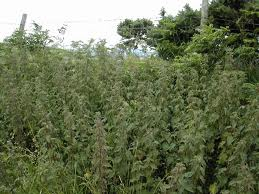
Human settlements that have long since been abandoned can be spotted by archaeologists as nettles still grow there.
Nettles at Danehill Fort
The plant is listed as one of the Anglo Saxon nine sacred herbs. Samuel Pepys enjoyed nettle porridge on 25th February 1661 and Sir Walter Scott wrote about the gardener in Rob Roy raising nettles for use as early spring kale (Mabey 2010).
The Romans are said to have brought Urtica pilulifera to Britain where they used them to relieve rheumatism and arthritis by flogging themselves with small branches of them tied together, this stimulates the blood. They also used them to keep out the cold of the damp British climate. However this species of nettle is not common in the United Kingdom.
Urtica pilulifera

Nettles Urtica dioica have been used to make cloth, paper, fishing nets, sails, tablecloths, ropes and textiles since the Neolithic times. The German army used nettle for their uniforms in World War 1 However it took 40kg of nettles to make a single shirt. In the Second World War the leaves were used to make the green dye for the military uniforms. Today nettles are again being used to make cloth as they are Eco-friendly and easy to grow. The tough fibres from the stem are used to make the cloth. It is reported that it is stronger than cotton and finer than hemp. People used to sleep between the sheets made from nettles.
Nettle Cloth

Nettles can also be used to make paper, however the process is complicated
Nettle Paper

There are records of nettle fibres being spun into ropes.
Nettle Rope
The roots can also be made into a dye that is yellow (Mabey 1977).
The chlorophyll is used as a green dye and is listed as a food colorant (E140) by the European Community.

 changinglifestyleblog
Reblogged this on Science on the Land.
LikeLike