Cardiff art collection landscapes

Hi,

Once again I am here telling you about our weekend in Cardiff. The meeting of BWARS was on at the museum in Cardiff so I accompanied your father down for a break. When we arranged it I wasn’t aware that one of you would be coming home for a wedding. However by the time I found out the hotel was booked. In the end as you only passed through briefly on Friday night and Sunday evening I didn’t feel I was neglecting you.

We arrived early for the first meeting and parked in the long stay parking. The entomology department has been reduced considerably  due to cuts and they operate on a skeleton staff.

In spite of this there were several younger people at the meeting. After eating lunch, I skipped the ID session not wanting to spend hours looking at insects down a microscope. I signed up for the free art tour and we were shown around by a volunteer who took us to see the landscapes.

The first landscapes were from the early seventeenth century and appeared more as architect plans for a house and garden than paintings. They were  designed to show off how wealthy the owners were and thus how much land they possessed.  Of course now that the house and gardens no longer exist it is invaluable to historians who want to find out how these houses were laid out and how the gardens of the time were designed. On painting is of the front of the house and gardens and one of the rear. On the right you can see the sea in the background

We were lead on a whistle stop tour through some Poussin landscapes where we were shown how the story of the picture had diminished over time and the landscape had come to dominate the canvas.
imag3500

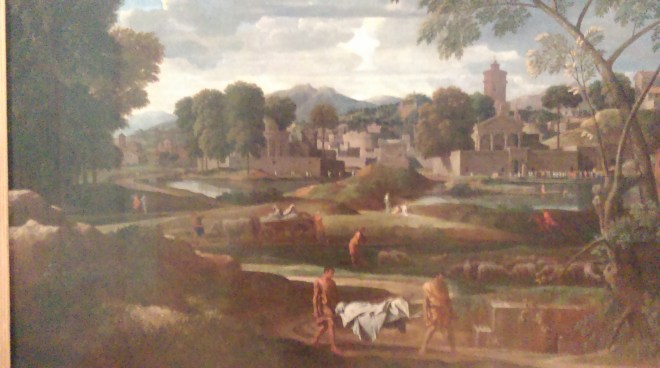
The story of this particular landscape is of a general who had been falsely accused forces to commit suicide and here his body is being taken out of the city of Athens for disposal elsewhere. Late in the story he is pardoned so his grieving widow brings his ashes back for a proper burial in the city.  The other painting in this pair shows the widow of the general gathering up his ashes so that she can return them to the city.

Well that’s all right then unless you are the dead general. Anyway this particular painting was bought by Clive of India who had similar problems to the general in the painting without (thankfully) the forced suicide.  Perhaps he empathised with the plight of public humiliation of someone who had worked so hard for their country, perhaps he thought that his reputation would be cleared?

In the Nether;ands in the 17th century the merchant class grew after the end of the wars with Spain and as a result artists flourished as wealthy patrons looked for something to spend all that money on and show how wealthy they were. In this picture the scene is painted from a boat anchored on the water.

I expect if you were a merchant the last thing you would want on the wall sis a storm at sea, reminding you off all that investment perilously sailing to your customers. Consequently here it is very calm and the water is barely moving. Again for historians this provides a great deal of detail on costumes or ordinary sailors at the time and how the boats were designed. The sailing boat with the bent mast is a sail that is opened downwards under gravity rather than being hoisted. The operation requires fewer sailors and such sails were used on London barges of the time.

Then the pastoral movement provided bucolic scenes of plenty and contentment from artists that were removed from the daily privations. No mud, no toil, no smells, no poverty, no exploitation, just happy shepherds and milkmaids.

Here is a Gainsborough.

imag3449

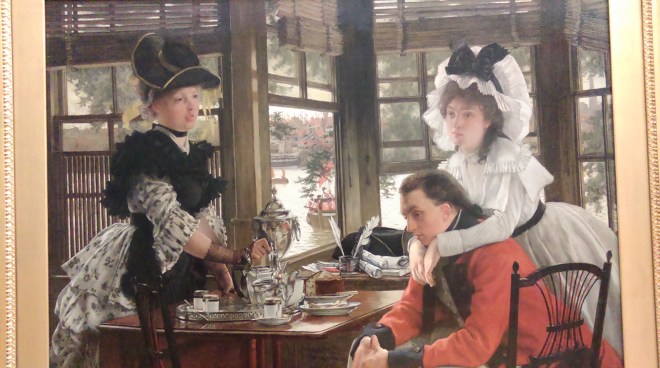
This soldiers farewell was one of my  favourites, although the sentiments are maudlin and very Victorian the picture is almost photographic in the portrayal of the scene and so sharp. I felt I could touch the scene. (Of course I didn’t try). Fanciful I may be but not deluded.
imag3410

At the end of the nineteenth century came the impressionists and here the landscapes have an unfocused dreamlike quality. thanks to the generosity of two sisters who bequeathed their collection to the museum there are many impressionist paintings.

The bottom painting on the right reminded me of lake Anguilara although it is London.


These next paintings were painted by  Alfred Sisely and are a couple of views of the coast of Wales. He  was born and lived in France, but was a british citizen. He had a French mistress with whom he had a number of children. However it was the law that if you were not married neither your partner nor your children could inherit. So his mistress put her foot down and they came to the UK and to Wales presumably to keep things quiet in case of a scandal and they were married in Cardiff.  Once married there was no problem about the inheritance. During their honeymoon he went out painting every day and the result are these charming landscapes. He was one of the impressionists who believed in painting in the open air  “en plein air”. The museum has two lovely paintings of the Welsh coast that he painted at this time.


It is curious to think that had the railway not been developed artists would have found it much more difficult to travel to out of the way places to paint. In addition paint was produced in tubes making more portable, no more grinding pigments and mixing them every time you wanted to paint. Canvases were pre-prepared so they could be carried around . Do you agree? This impressionist painting reminded me of those intense dreamlike landscapes of Van Gogh.

imag3570

These tiny landscapes were lovely  despite being over 200 years old they appear curiously modern. I think it is to do with their  brightness, clean lines and clear colours. Again they had that photographic quality.  I liked them.


Finally here are the last few landscapes the first in a John Singer Sargent known for his portraits but here he paints a tyrolean landscape with two figures reclining. Almost photographic it draws you in.


Here are a couple of twentieth century paintings one of men making hay more modern happy peasants and the other cute children by the seaside. Both were utterly charming and portray an ideal world. After horrific wars perhaps people wanted to believe that the world would become a better place or perhaps they were harking back to an earlier more leisurely romantic time. What do you think?


Liverpool The Walker Art Gallery

When We visited Liverpool we had not got an agenda for the afternoon so there we were at the Albert Dock with three and a half hours before we would be picked up again. It was raining the sort of rain that doesn’t seem that heavy, but before you know it you are soaked and getting very chilled  so our first priority was to keep dry.

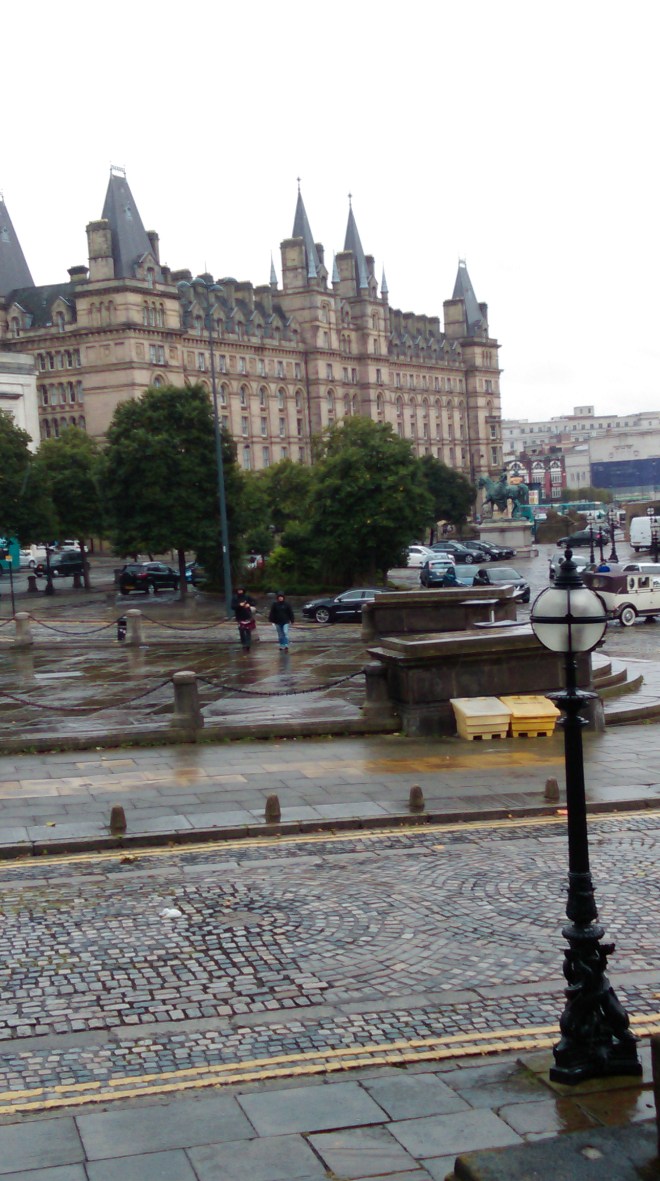
Here is a rainy Liverpool. It is difficult for anywhere to look appealing when it is wet.

We visited the tourist information office for a map and a look at the bus timetables but the centre was so crowded we decided to walk to the Walker Art Gallery. I know the Liverpool Tate was closer but I don’t really understand most modern art and some of it irritates me. I wanted to enjoy my time in this city so we headed out to the gallery. So here we are outside the gallery.

IMAG3229

It was free which is always a lovely surprise with a great high ceiling and central space downstairs. As you can see the building is reminiscent of the Natural History Museum and Science Museum in London and not too different from The Natural History Museum in Oxford. Perhaps they built all these buildings from a common template.

IMAG3227

I really wanted to see the Pre-raphaelites so we made our way to the 19th Century gallery.

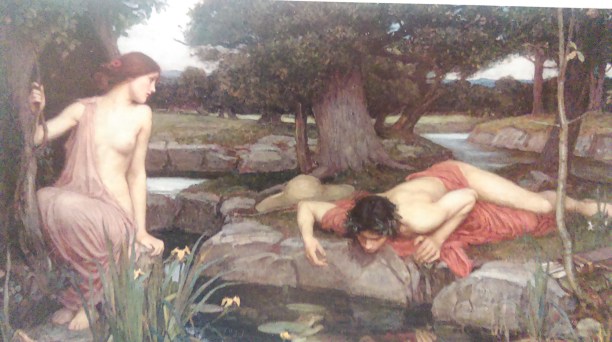
Here is Echo and Narcissus

IMAG3288

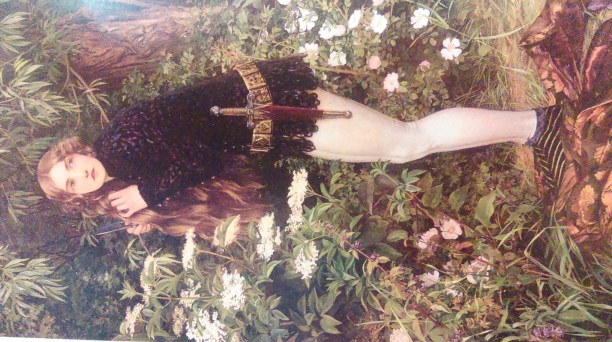
And here is a cross dressing page

IMAG3290

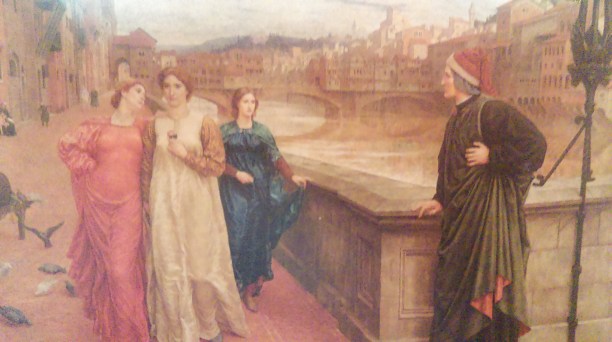
When I find out how to rotate this I will. This is from the story of Dante and Beatrice. In this painting she is ignoring him, but her friend is quite obviously checking him out.

IMAG3289

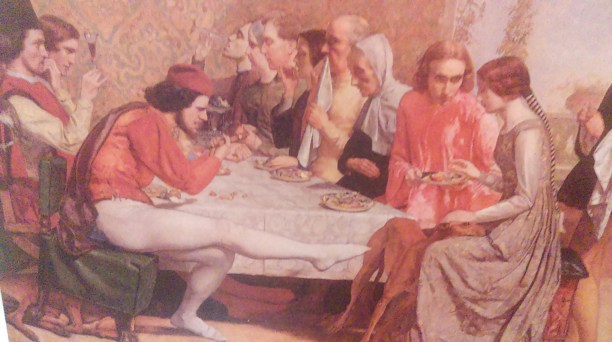
This is Isabelle from the Prom Isabella and the pot of basil by Keats. If you don’t mind growing your basil in a pot containing your dead lover’s head it is a fine tail. Looking at the picture and the expressions of her brothers it isn’t really difficult to tell who is responsible for the loss of his head.  I did think if you were to wear tights that are that close fitting you shouldn’t try to kick the dog IMAG3286

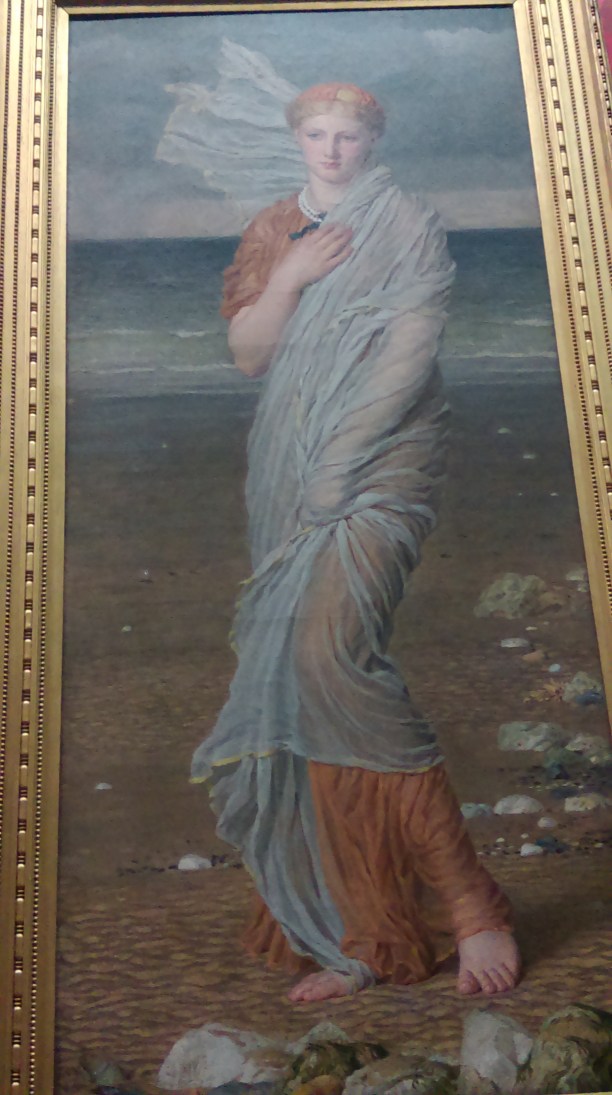
I rather liked these two women of Phoenicia. They look more substantial that the picture above more like real women that the fantasy of some anaemic idealised figure. I also like the fact they are not looking out at the observer. I think this was painted for the drapery.

IMAG3221

This is earlier and more idealised but still she appeared more real than many of the figures.

IMAG3214

Another picture painted for the drapery. Her face is totally closed and expressionless.

IMAG3220

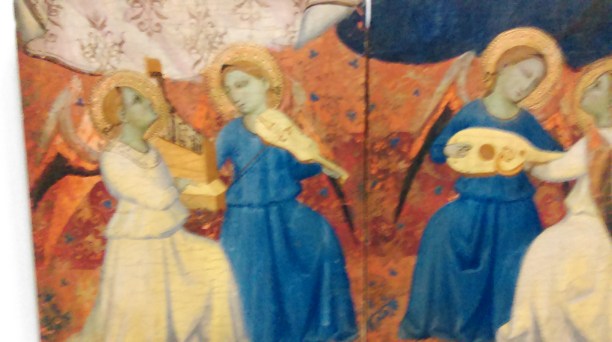
This isn’t a great photo despite not using flash the lighting bounced off the picture . I liked that they were all playing music.

IMAG3222

More angelic musicians here. Is it me or do they look a bit pallid and unhealthy?

IMAG3217

Finally one that puzzled me. Any ideas?

IMAG3219

I found a few Dutch old Masters the old man is by Carl Fabritius and he young man is  a Rembrant self portrait. There is such calm and poise and space in these paintings. I hadn’t expected to find 17th century Dutch masterpieces her so it was a lovely surprise.

IMAG3291

Here is the famous Hans Holbein portrait of Henry VIII. Those little piggy eyes and huge jowls just make me shiver. I heard last week on a history programme that 72,000 people were executed during his reign.

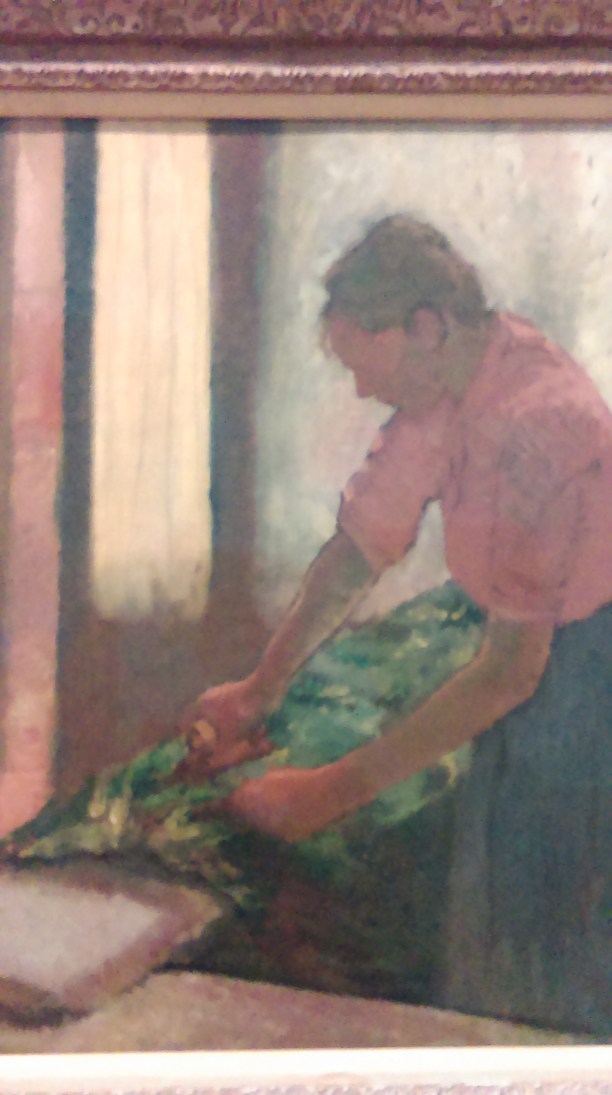
The final portrait I photographed is an impressionist painting of a poor woman ironing. No posh clothes or fine jewels but I felt closer to her than the grand beauties. Isn’t it always the case that behind the scenes there is some impoverished woman cleaning or ironing or cooking unnoticed and unrecorded for the most part.

IMAG3225

This is a modern work of two girls dancing. There is such an expression of abandon and movement and excitement I had to photograph it.

IMAG3226

When we emerged it had stopped raining and look how much more attractive it suddenly becomes.


This was a wooden installation in the middle of the streets and shops. Isn’t it fun.


Back at the docks we took yet more pictures. The swans are a species unique to this area apparently.


Ice hockey

Dear Sons,

In an attempt to try new experiences and expand my comfort zone I went with my friend Angela to a Nottingham Panthers home game at the ice stadium on saturday.

imag3399

We started with a drive into town and parked in hockley. I like Hockley the eclectic mixture of shops and restaurants the slightly offbeat industrial nature of many of the buildings the jumble of styles. There was a real buzz in the air and it was so busy. Lots of families, all kitted out in panthers shirts. We had half price pizzas and a drink at pizza express. They were real Roman pizzas with the thin crispy crust and the fresh fillings, indeed it was one of the best pizzas I have had outside Italy.Even the mozarella tasted as it does in Rome.

So thoroughly stuffed we made our way to the ice ring and found our seats at the very back of the stadium. Oxygen masks were not provided so I had to gasp for a few minutes.

imag3394

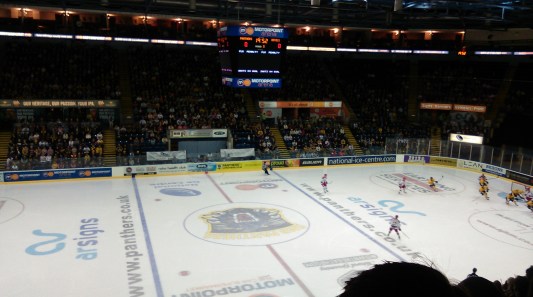
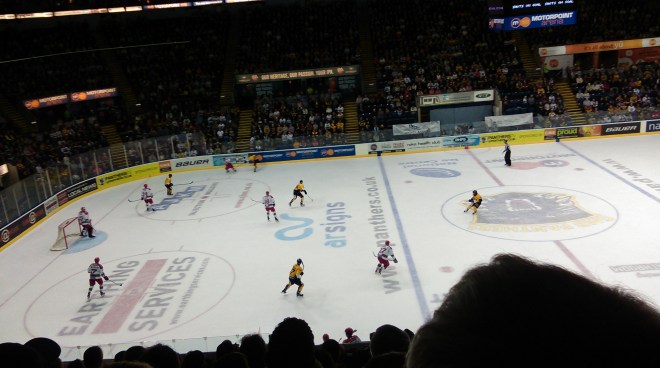
The match was exciting even for me who does not do spectating sport. Three twenty minute bouts with a fifteen minute break in between each bout. There was a lot of showmanship and hype but it was all good natured. Five players and a goalie from each team attempt to get the puck into the net with the hockey sticks. The panthers were in black and yellow.

imag3408


Whereas the Cardiff Devils were in red and white

imag3405

It was pleasantly free from bad language and aggression. Indeed small children and elderly people were present in numbers and many families had come to see the game. There was even a newborn in a pram, although the baby hadn’t come on its own.

There was chanting and singing and gestures to accompany the chanting and singing. The supporters were very partisan towards the Panthers and when the Panthers scored their first goal, everyone stood up and cheered and chanted.

There was no violence or intimidation as there is at football and it was an extremely pleasant evening. On the pitch however there was quite a bit of pushing and shoving mainly to gain possession of the puck, but there was definitely more aggression on the pitch than off it.  Such antics were described by the bloke sitting behind me as ‘love taps’. Presumbly just as a Glasgow kiss is a headbut.

imag3395

The players in their gear looked huge but apparently without the protective clothing they are all quite slim and nimble. They could certainly move quickly and were very agile. Occassionally one would collide or be shoved into the side of the ring or there was a hiss as they turned their skates to change direction suddenly. The puck flew into the barrier around the ring fairly regularly and I found myself grateful for the barrier.

Players were sent off for various infractions of the rules and they would sit beside the ring for a couple of minutes. I didn’t understand enough of the rules to understand what the infractions were so I can’t comment. Every so often players would leave the ice and other players from the team would substitute. Therefore though only a few players at a time were on the ice the teams were much larger than those few players.


After each bout a young child would come onto the ice and perform a figure skating routine with jumps and turns and whirls. As they were under ten years old this was impressive. The mascot, in a puma costume walked around the stands giving out flowers and goody bags to people.

imag3401

The console flashed with messages for birthdays and anniversaries and reminded the audience when to chant and sing.   The Panthers scored two goals and managed to prevent the Cardiff Devils from scoring which was a tribute to their defensive skills as the Devils were on good form.

In the intervals a machine was driven around the ring to clean the ice. I would like to have driven this machine.

imag3398


The whole thing had finished by half past nine and I was home for ten o clock.

I felt as if I had been to a fair or  circus without the sick feeling from being thrown around and eating junk food. Just the light feeling of having been out with lots of people and the lights and shared songs and being part of something tribal.

Anyway I hope you like the pictures I took.

Your loving mother


The Leonardo da Vinci exhibition at the castle

Dear Sons,

On Sunday we decide to go to Nottingham castle to visit the exhibition of da Vinci drawings that have been loaned from the Royal Collection. As usual on a Sunday we had a number of jobs to do before we could go and it was late morning before we got the bus. Parking in town has become so expensive and difficult we preferred the bus.

img_2193

These were studies for a giant statue of a horse in bronze. However when the French captured the city the soldiers used his initial model for target practice and the statue was never built.

It was lunchtime when we reached the castle. At the moment if you pay for entry you get a years membership so it is worth paying. Both of us have  a years membership. It was a lovely late summer day just right, sunny but not too hot and with a light breeze to keep the temperature down.  We enjoyed the views over the city and pointed out landmarks for each other. The exhibition was upstairs next to the art gallery. Dad had brought his camera and took some photos so I could send them to you  (without flash of course).

img_2191

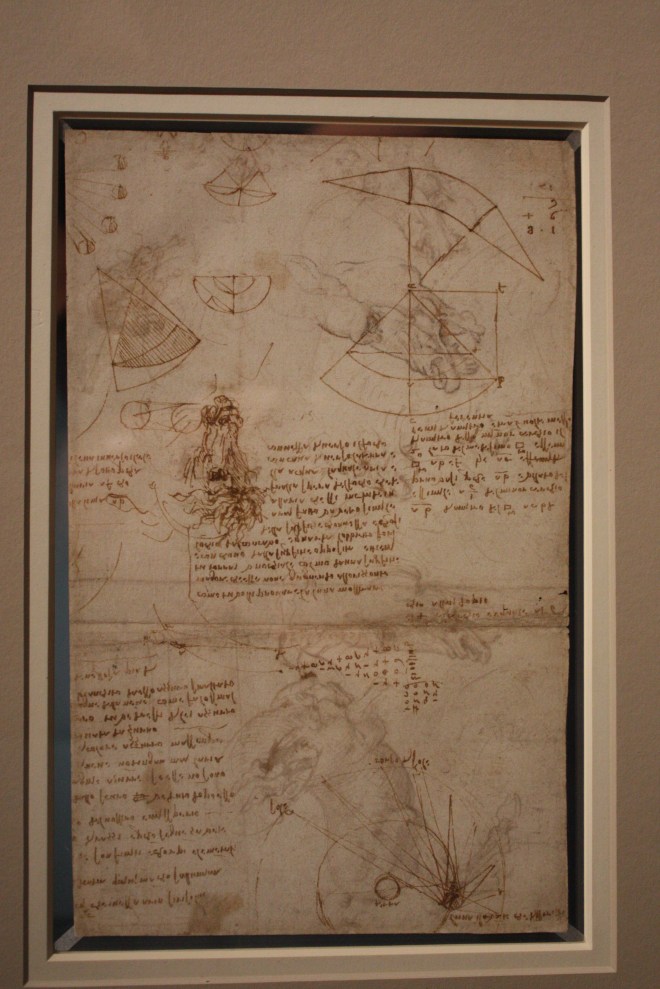
 These drawings are astronomical

Although there were only ten drawings in total, there was a video showing how the paper was prepared and the drawings executed. I found this fascinating. Then boards with details of Leonardo’s life and works. I was photographed as the Mona Lisa for a giggle I should crop it and use it as my avatar perhaps?

Finally we got to view the drawings and they were magnificent. Much smaller than you would think but so beautiful and enchanting in their perfection and playfulness. You could see where he had tried out ideas and scribbled notes and lines of poetry.

Here are some studies of felines of various species. I particularly like the miniature dragon

img_2183


It was all so much more intimate than seeing  finished art works. It felt as if we were seeing inside his thoughts, not quite as intimate as reading a diary, but an insight into the mind of a genius. Having seen the materials he had to work with, made the delicacy of the writing and the fine lines of the drawing all the more impressive. I had to keep reminding myself of how ephemeral these images are and how many hundreds of years ago they had been produced.

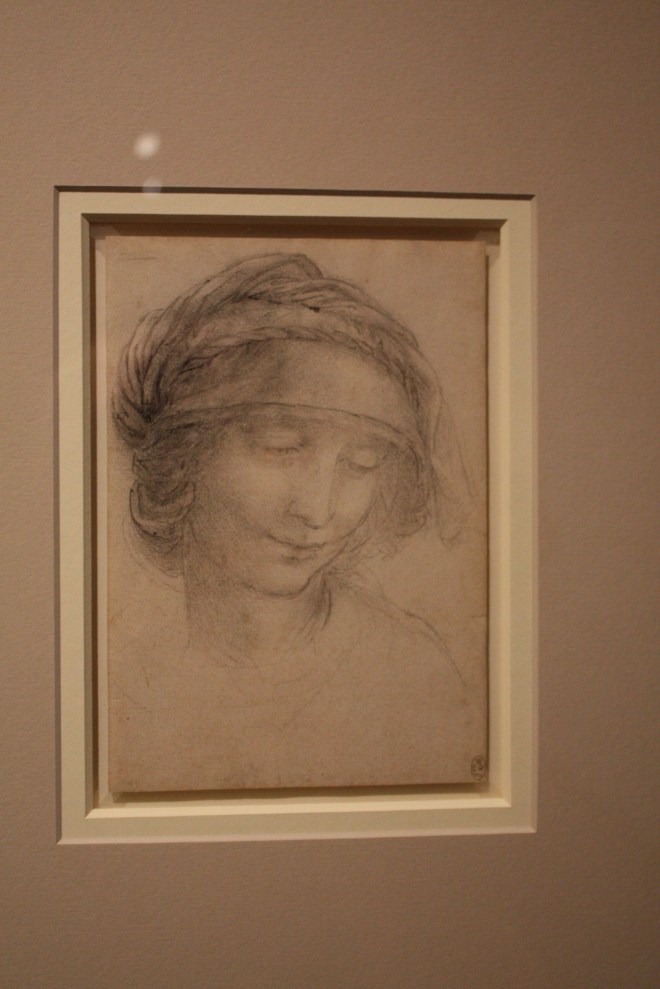
This is a study for the head of Saint Anne the mother of The Virgin Mary the final piece shows St Anne with Mary on her lap and the infant Jesus

img_2180

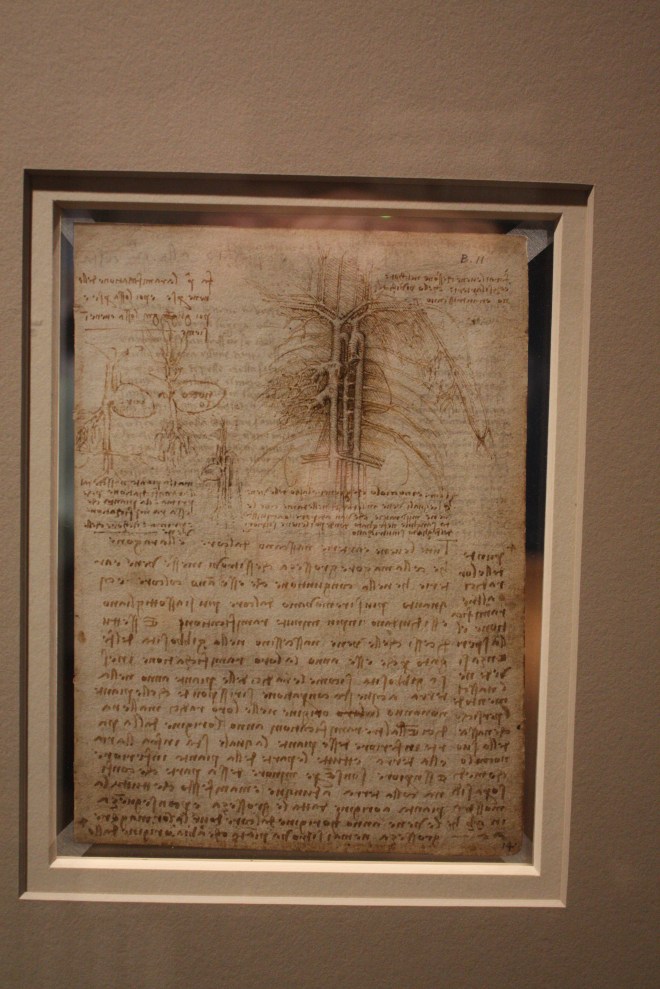
Here is a diagram of the circulatory system

img_2177

Here the diagram shows an enlarged pancreas and a small liver. It is inconceivable that such a meticulous draughtsman would have made an error, which could indicate that the subject whose dissection was the source for these drawings had diseased organs.

img_2171

We finished the visit by wandering through the artworks showing each other our favourites. I like the Laura Knights’ whereas Dad prefers the more romantic realistic landscapes. We debated the species of dragonfly in one of the still life paintings I argued for black tailed skimmer he favoured broad bodied chaser. We had lunch in the cafe and pottered back mid afternoon to do some work on the garden.

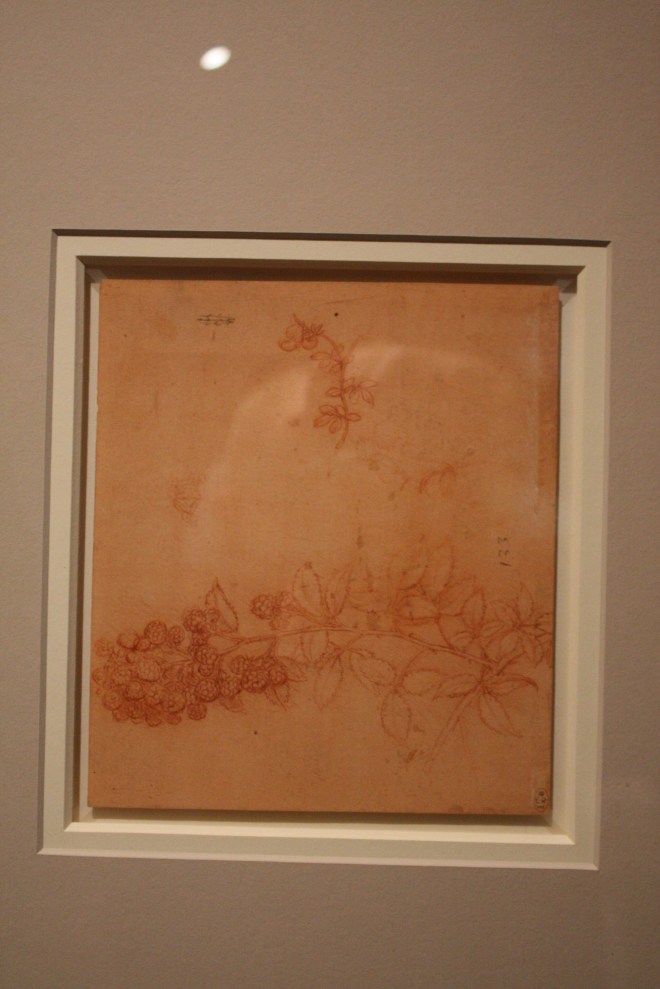
This drawing of blackberries is in chalk such an ephemeral material and it has survived all these hundreds of years.

img_2169

We bought the book of the exhibition and when we have read it we will send it to you. Well that is all my news for this weekend.

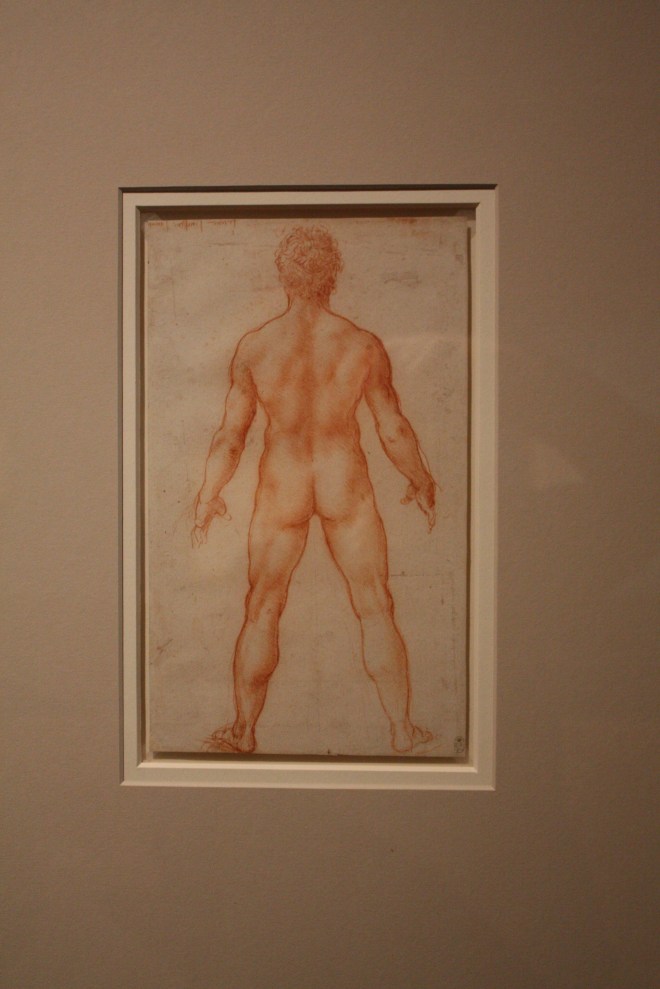
This figure is rather short and stocky but again incredibly well preserved considering the drawing was done when the wars of the roses were taking part in England.

img_2161

This is a storm scene

img_2189

Attenborough early September

Dear Son,

I though I would update you on how our trip round Attenborough went last Sunday. By the time we had finished phonecalls it was later than we had hoped. However the weather was perfect so we set off quickly before any other distractions came along.

Just outside the sand martin hide were two common sandpipers. David photographed them on his phone. In case you were wondering it is near that big clump of vegetation.

photo0005

See what I mean about it being a beautiful day. At the corner of the building a

female goosander was sat somewhat incongruously.

photo0007

From tower hide we watched a raven fly across to Barton in Fabis and a buzzard circling the woods opposite. A black necked grebe was trying to hide in amongst the little grebes and a green sandpiper tried to look inconspicuous amongst the dunlin on the long island. There were more reed buntings than last time. The statistics for fledging cand martins were encouraging this year most of those ringed had fledged.

A kingfisher flew across but I missed it as it was so rapid. Three little egrets saw amongst the ducks and black headed gulls. Most of the ducks were in eclipse but it was good to see the return of some of the winter species, shoveler, a few widgeon as well as the commoner teal, mallard, tufteds and gadwell. we heard several Cetti’s warblers always skulking in bushes. Snipe were lurking at the edges of the islands and several ringed plovers were patrolling. occassionally we would see a duck that had completed its moult and it stood out as being particularly splendid. It has been so long since we went birding I found myself fascinated by watching tufted ducks diving the look so much more elegant under water. I hadn’t noticed how bright the yellow eye is nor how its colour is emphasised by the black pupil at the centre.

We walked to the old fishermans’ car park at a gentle stroll. We found a mixed flock of tits, lots of long tailed tits flitting through the trees calling incessantly, but also blue tits and great tits associated with them. A female blackcap was tagging along and both robins and wrens were present.  from the centre of the village we headed beside the works pond towards the bund most of this pond has been filled in with sediment from the gravel extraction. I finally saw my own kingfisher low over the pond. We moved though the wood towards the railway line and the crossing where we turned towards the river. It is always quieter at this end and we had avoided most of the prams cyclists and pushchairs. We walked back along the river towards the bund and noticed that most of the great crested grebes were changing back to winter plumage. Our peace was disturbed by a speedboat on the river but apart from that it was a long languorous stroll. Common darters crossed the path ahead of us. Unfortunately they refused to pose as this one has so this is from the web.

common-darter

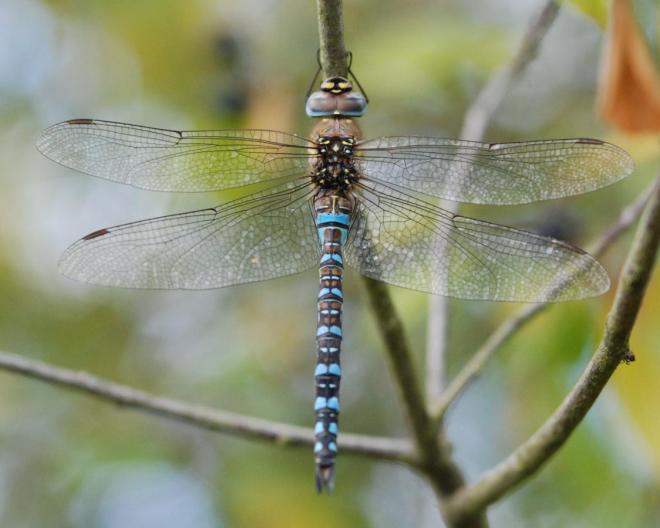
From time to time a curious migrant hawker would come to investigate us. One was so fresh it took your father some time to determine it wasn’t a southern migrant hawker as these have been seen in Essex. The image here is from the web as we only had a phone

migranthawker_jpg


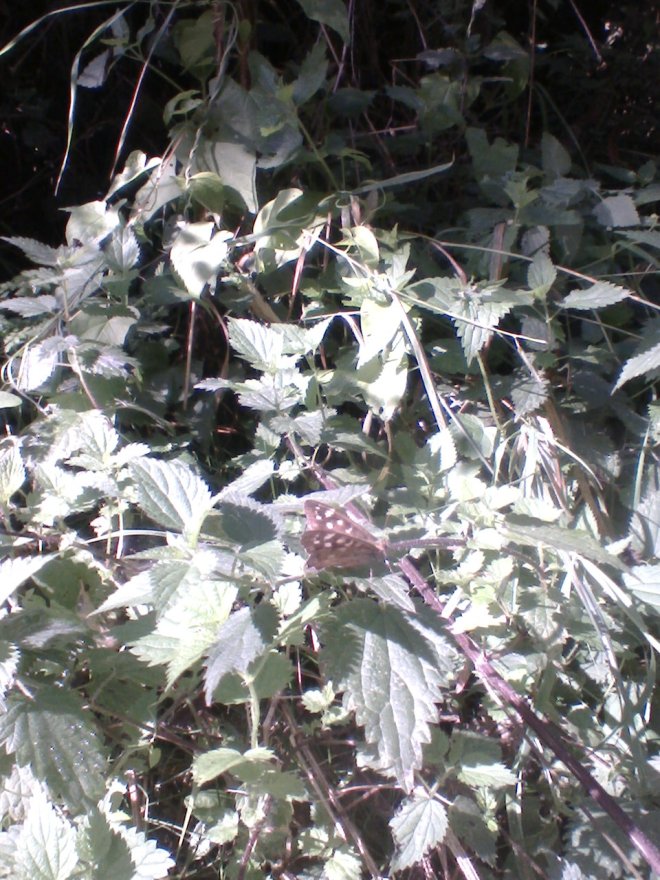
The late summer sun had also brought out the butterflies many of them speckled woods but also small and green veined white, comma, and red admiral.

photo0014

There were many honey bees feeding on the hymalayan balsam that has returned and some common carder bees Bombus Pascorum. We also found a bee mimic, volucella bombylans this large hoverfly resembles a bee.

hoverfly-volucella-bombylans-var-bombylans

The brilliantly named marmalade hoverfly Episyrphus balteatus was everywhere.

marmalade-hoverfly

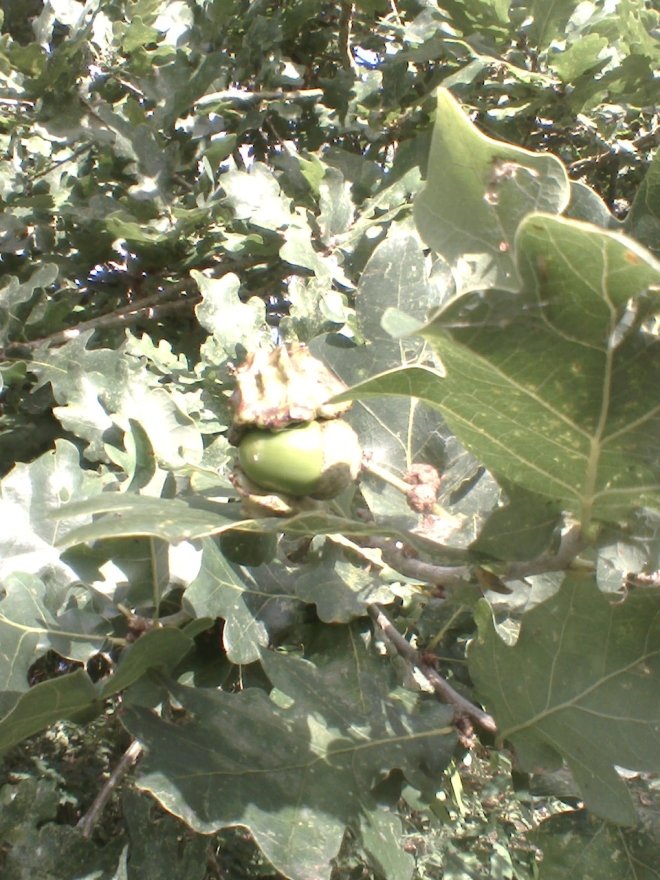
The oak trees were full of acorns so there were jays magpies and squirrels. Many of the acorns had knopper galls on them as you can see here.

photo0018

We walked five miles saw fifty two species of bird as well as many insects and plants and had a wonderful sunday morning.

Since we returned we have found a rove beetle in the kitchen and a moth caterpillar on a pile of books at school. The temperature today has exceeded that in Morocco and we are having a mini heatwave.

Much love Mum

Wildlife of Dungeness

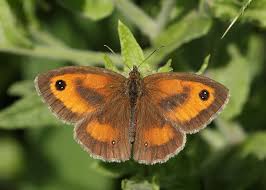
As we were staying in Hythe we used the Romney, Hythe and Dymchurch railway to visit Dungeness. It was a remarkably windy day but it was dry and the sun was shining intermittently which is something to be pleased about in England. Accordingly we did find quite a few invertebrates and plants.There were several species of butterfly. The gatekeeper with the two spots in the forewing. Pyronia tithonus.  Image is from butterfly conservation they were too flighty to photograph

download


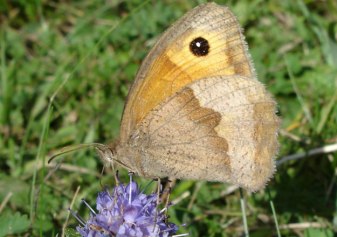
A number of meadow brown butterflies Maniola jurtina. Image is from butterfly.org as they wouldn’t stay still for us.


meadow-brown-underwing-female-martin-warren-web

There were a number of common blue butterflies. Polyommatus icarus. Here is a photo from butterfly conservation to illustrate the species.

common-blue-underwing-male-ketih-warmington


We found a couple of Painted lady butterflies Cynthia vanessa. These are often migrants blown across from the continent.

Painted lady


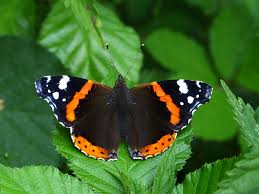
We also saw at least three red admirals Vanessa atalanta.

red admiral


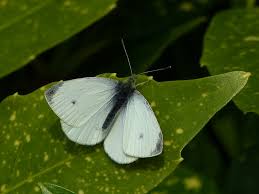
Alongside these were both large white butterflies Pieris brassicae, small white butterflies Pieris rapae and green veined white butterflies Pieris napi. In the past these three species were all grouped together as cabbage white butterflies.

Green veined white and large white with small white beneath. The photos are from butterfly conservation to illustrate the differences.

small white butterfly


We found the carline thistle Carlina vulgaris . I had not seen one before and I was struck with its  architectural shape.

Carline thistle

Beside the train station we found the aptly named yellow horned sea poppy. Glaucium flavum.   It only grows along the sea shore. It is toxic but I found it very attractive. (Sorry a bit of whimsey here). It even features in a poem.

Yellow-horned sea poppy

A poppy grows upon the shore,

Bursts her twin cups in summer late:

Her leaves are glaucus-green and hoar,

Her petals yellow, delicate.

She has no lovers like the red,

That dances with the noble corn:

Her blossoms on the waves are shed,

Where she stands shivering and forlorn.
Shorter Poems Robert Bridges


Sea kale  Crambe maritima was abundant it always appears so leathery I am surprised it was once considered a popular vegetable. Although I would not recommend gathering any plant material from a nature reserve

Sea Kale

In Dungeness a species of  bumble bee used to live.  Its latin name is  Bombus subterraneus but commonly it is called the short haired bumblebee. It is one of  only 27 bumblebee species native to the UK. (This is one reason for learning to identify them, twenty seven species is manageable whereas over 2,000 moths is less so).

(This image is from the BWARS website as we didn’t find one.)

bombus subterranis

This bee was once widespread across the south of England, occurring as far north as Humberside, but from the 1960s onwards its population declined, probably due to the loss of species rich grassland habitats. Consequently its distribution became fragmented with colonies isolated. It was last recorded near the RSBP Dungeness nature reserve in 1988 and declared extinct in 2000.  Thankfully a population of UK origin survives in New Zealand, where they were introduced in 1895 to pollinate red clover. Attempts were made to captive rear and export queens back from New Zealand to the UK but with limited success. Results from genetic analysis showed high levels of inbreeding. Thus, in 2011, Natural England and the project partners agreed to change the reintroduction source location from New Zealand to a European source. Sweden was chosen as it supports the most robust population and has a broadly similar climate to the UK. Once suitable source locations had been found, a sample of bees were collected and  checked for diseases. 89 queen bees were collected from southern Sweden and put into quarantine. At the end of May, 51 healthy queens were released at RSPB’s Dungeness reserve. This process was repeated the following year with 100 queens bees collected and 49 released. During July that year seven workers were seen in the Dungeness area, one of which was melanistic (dark form), proving that at least two queens had successfully founded nests. In Spring 2014 a further 46 healthy queens were released at the Dungeness site and during July and August that year, three worker bees were seen around Dungeness and a fourth outside the area, providing encouraging signs that the bees may be nesting in the surrounding area. In 2015 25 queens were released in the site and three workers were seen in a single day and over the following four days. This indicates that  the habitat is suitable to support a healthy colony.  We searched extensively for this bumblebee but we didn’t find any. Since it is a huge area this is not surprising but rather disappointing.

Despite our disappointment we did find large numbers of most of the common species of  bumblebee;

The common carder Bombus pascorum, (Image is from BWARS website).

bombus pascuorum


The white tailed bumblebee Bombus leucorum,


Common Carder bumblevee on teasel

The buff tailed bumblebee Bombus terrestris (Image is from BWARS website)

bombus terrestris 2


The red tailed Bumblebee Bombus lapidarius. (Image is from bumblebee. org)

bombus lapidarius


We found the wind rather trying whilst we attempted to photograph the insects and consequently many of the images are from butterfly conservation or BWARS images.

We also found common blue damselfly 

Enallagma cyathigerum

Small Gardens

I am fascinated by what can be done in a tiny space with a small yard or strip of garden and here I want to share some ideas I found on holiday. They say that Kent is the garden of England and whilst I thought it was full of gardens, many counties of England are full of beautiful gardens. Indeed gardens are something we do very well.

I believe it is relatively easy to make a lovely garden in a larger space where there is room for a water feature, trees a shade area a lawn bedding plants etc. Not to mention the money to buy all these things and perhaps a gardener to care for it all.

However, to make a small awkward area look interesting is much more challenging.

Here are some of the ideas I have seen and photographed on my travels this summer.

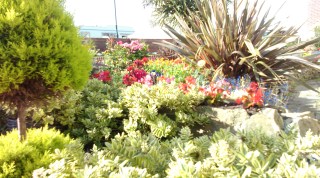
This is the garden of the hotel where we stayed.

IMAG2950

I thought it was rather a tribute to bedding plants and brash colours but in the sunshine it was rather pretty. I would rather sit amidst flowers and shrubs that surrounded by grass and concrete.


IMAG2952

It is amazing what you can make with a narrow passage beside your house. This one was in Hythe.

IMAG2744


If however you only have a wall and your plants get wind blasted and salt encrusted. It is still possible to plant in containers. What a great idea these were!

IMAG2761


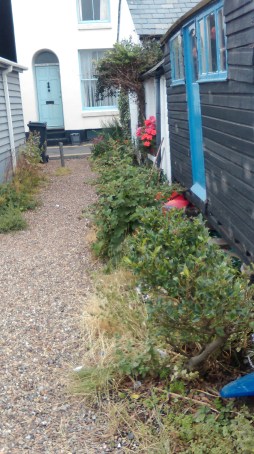
Once again this time a narrow strip between two houses this time just behind the sea wall so subject to salty winds and storms. This is a real garden complete with a few weeds and grasses.

IMAG2764


This garden really made an effort not only was there the model pheasant on the balcony, but the plastic crabs and lobsters  next to the front door. I don’t think I would have them in my garden but beside the beach it didn’t look too tacky. I am not too sure about the pirate flag though. Just as well those troughs are secured.

IMAG2760

IMAG2758

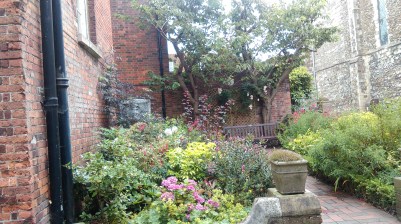
Then there was a small space in Rye between the church and the street, that was overflowing with plants. It was very romantic and atmospheric.

IMAG2857

Even where there were three storey victorian houses, many of the small patches of garden had been lovingly nurtured. This one was just beside a basement and had to be photographed over the wall looking down. I was inspired with how much could be done with just a few metres of space.  Again this one was in Hythe.

IMAG2724

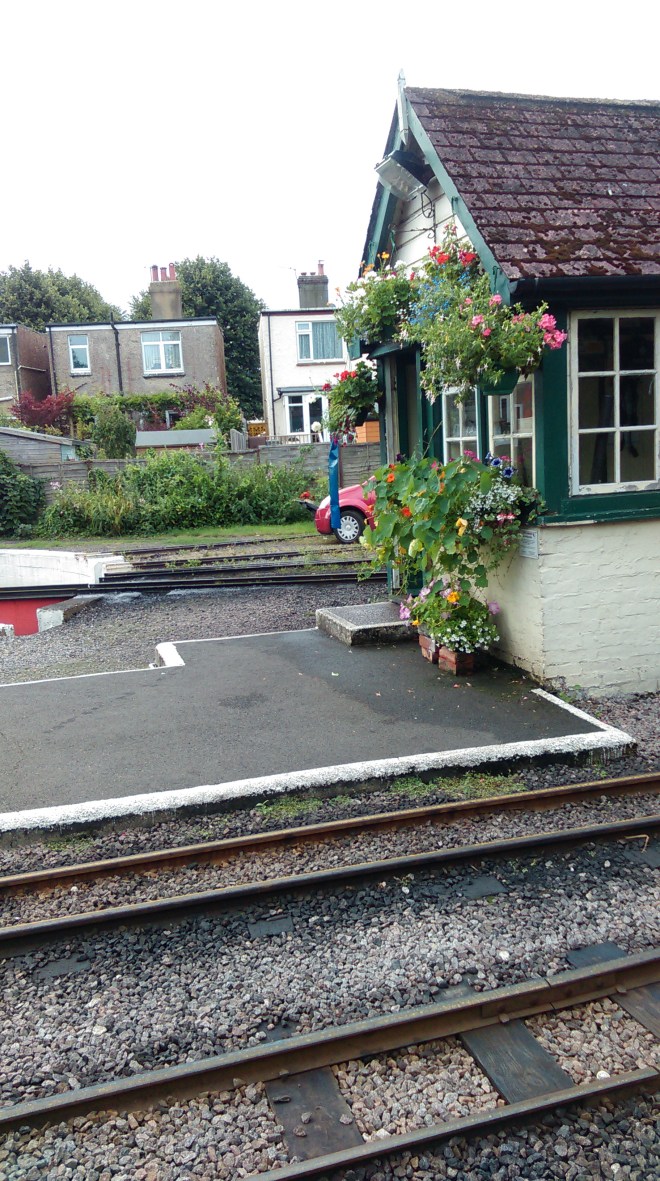
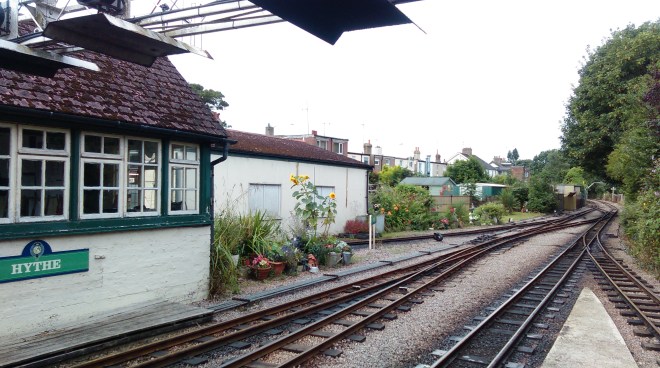
Finally the Romney Hythe and Dymchurch had its own style of gardening. The small gardens beside the tracks tended to contain small models of animals and gnomes. However, the signal boxes and stations had some really lovely tubs and hanging baskets.

IMAG2890


Railway sleepers obviously make excellent plant containers. The gauge on those railway lines is approximately 15 inches and this shows in the photograph above.

Do you have any ideas of what can be done in a small space?


Hythe The military canal and history

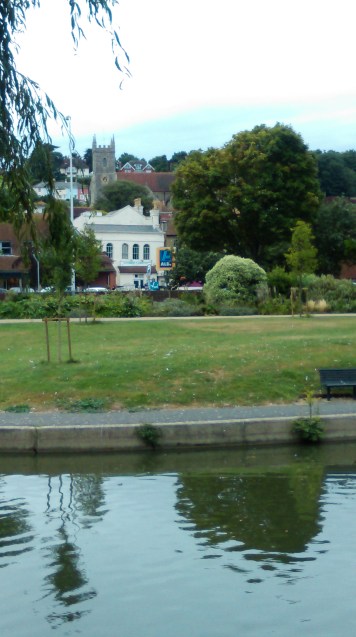
Whilst we were staying in Kent, every morning we would get up early for breakfast and then go for a walk for about an hour after our evening meal we would go for another walk. Many of these walks were taken either along the beach or along the military canal. The  canal was built in the early nineteenth century in order to defend the  coast against invasion.

IMAG2738

The Romney Marsh had been left virtually undefended in the belief that it could be quickly flooded and the subsequent boggy ground, criss-crossed by drainage ditches, would be impassable. The threat of Napoleonic invasion led to questioning of this  view. After much deliberation Lt-Col John Brown, Commandant of the Royal Staff Corps, decided that flooding the marshes was unworkable, it would take too long, if the threat proved a mistake many homes and much farmland would be destroyed. Therefore he suggested that a canal be built from Seabrook, near Folkestone around the back of the Romney Marsh to the River Rother near Rye, a distance of 19 miles. The canal system would have sources of water from the sea and the River Rother. It would be 19 metres wide at the surface, 13.5 metres wide at the bottom and 3 metres deep. The excavated soil would be piled on to the northern bank to make a parapet, behind which troops could be positioned and moved out of sight of the enemy. The canal would also have ‘kinks’ to allow enfilading fire along the length of the canal, if the enemy attempted to cross it. I know it seems a bit silly to think that an army that had marched across much of Europe would be stopped by a deep ditch.

IMAG2732

On October 30 1804 excavation of the Royal Military Canal was commenced. Harsh winter weather and severe flooding, as well as difficulty in attracting labourers called navvies delayed the completion and by May 1805 the canal project was close to disaster: only six miles had been completed and work had stopped.  The Prime Minister William Pitt intervened: the contractors and Rennie were dismissed.

The project was put in the hands of the Quartermaster-General’s department with Lt-Col. Brown in command. Navvies dug the canal, while the military built the ramparts and turfed the banks. Flooding continued to be a barrier to progress and hand pumps were used day and night to keep the trench from filling with water. Eventually powerful steam-driven pumps were used to clear the water.

Here is a picture of the monument to the navvies who built the canal

IMAG2817


At its peak there were 1,500 men working on the canal. The canal was dug entirely by hand, using picks and shovels and the soil was carried away in wheelbarrows. Once the canal was dug it was lined with clay. The change of command and the greater work force speeded progress so that by August 1806 the canal was open from Seabrook to the River Rother.
However, the original dimensions of the canal were greatly reduced due to increasing problems encountered by the builders and pressures of time, so that for most of its length the canal is half its projected width.

Iden Lock was completed in September 1808, which linked the canal to the River Rother and Rye Harbour, effectively turning the Romney Marsh into an island, but it wasn’t until April 1809 that the canal was actually completed.

Plaque to the canal


IMAG2818

By the time the Royal Military canal was fully ready for use, the threat of invasion had long since past. Napoleon’s plans for invasion suffered a major setback following his navy’s defeat at the Battle of Trafalgar in 1805. He withdrew his troops from the French coast and focused his intentions on central Europe.

Map showing the route of the canal obviously we did not walk the entire length, but used it as a base to explore the town and its surroundings.

IMAG2736

The fact that the canal was never used for its intended purpose, cost £234,310 (a huge amount in Georgian England)  meant that the canal became an embarrassment to the Government – it was considered to be a huge waste of public money. It was cheekily called Pitt’s ditch after the then Prime Minister William Pitt

The radical journalist William Cobbett, who toured the country on his Rural Rides during the 1820s, was typical of the critics of the canal: ‘Here is a canal made for the length of thirty miles to keep out the French; for those armies who had so often crossed the Rhine and the Danube were to be kept back by a canal thirty feet wide at most!’

The Government desperately needed to find ways of recovering some of the money spent on the canal and in 1807 opened it to navigation and collected tolls for the transportation of produce and goods. In 1810 the canal was opened for public use and tolls were also collected for the use of the military road between Iden, Rye and Winchelsea. There was also a regular barge service running between Hythe and Rye, which took around four hours to complete.

Despite these efforts, traffic was never heavy, and the opening of the Ashford to Hastings railway line in 1851 further decreased its use. The Government was struggling not only to recoup the money invested in the canal but to meet the costs of maintenance.

Consequently, during the 1860s the stretch from Iden Lock to West Hythe was leased to the Lords of the Romney Marsh for 999 years at an annual rent of one shilling, while the the town of Hythe purchased the remaining stretch, that ran through the town, for conversion to ornamental waters. The canal west of Rye was sold to four individual owners. By the late nineteenth century the canal trade had all but gone. The last ever toll was collected at Iden Lock on December 15 1909.

IMAG2729

Despite previous doubts surrounding the canal’s usefulness for defence in the nineteenth century, it was quickly requisitioned by the War Department in 1935 as war in Europe became increasingly likely. The banks were lined with pill-boxes as the nation awaited invasion, this time by Hitler, but once again there was no invasion.

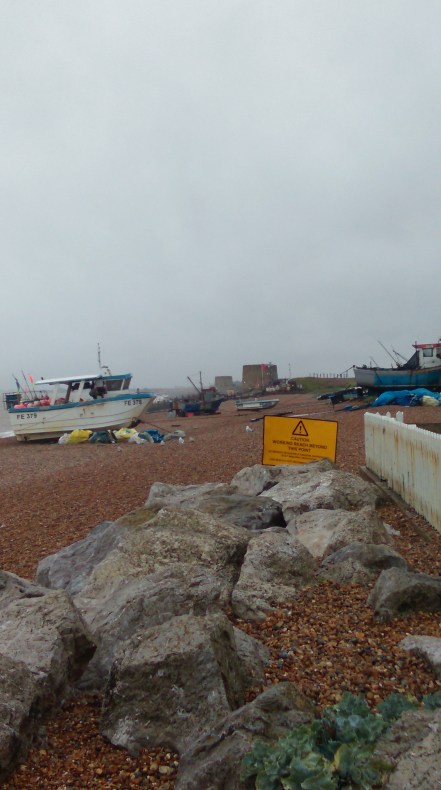
This is one of the Martello towers along the beach the red flag shows that the shooting range is active which is why the photograph is somewhat distant.

IMAG2749

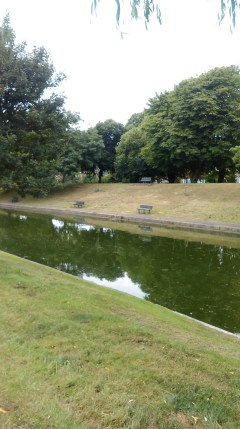
Despite never being used to defend the nation it is a very beautiful place to walk or cycle. There are boats that  can be hired. Trees flank the water and the usual assortment of ducks, geese and swans live on the waters. Herring gulls in all stages of maturity use it as a place to wash and clean their feathers not to mention scrounge any food from passing individuals.

IMAG2731

and it is much pleasanter to walk into Hythe along a beautiful tree-lined peaceful waterway that along a noisy dirty road with extremely narrow pavements. There are some parklands.

IMAG2815

Unlike the canals here in the midlands there are considerable more pleasure boats but considerably fewer supermarket trolleys, old motorbikes and other debris.

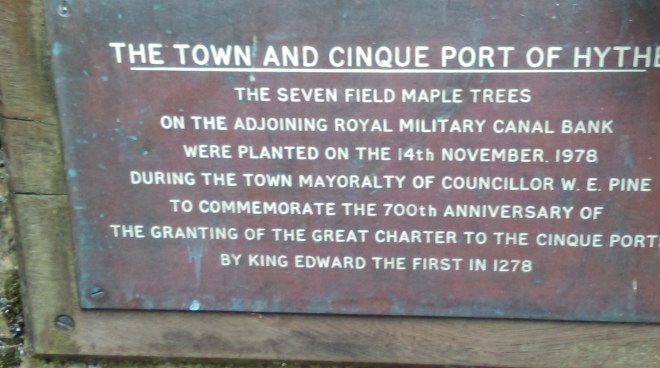
The town of Hythe has a long connection with the defence of the country. Hythe was originally one of the cinque ports (from the French for five, but pronounced sink), they comprised Hastings, Hythe, Dover, Sandwich and New Romney. However when New Romney silted up Rye took over as a cinque port. The earliest known charter to the Cinque Ports collectively (a general charter) was granted by King Henry III in 1260, but there is evidence that the Ports acted together from an earlier date.  It was found from the terms of those charters and other evidence, including the Pipe Rolls of Henry II and the Domesday Book (published in 1086), that the Ports had enjoyed common privileges in return for their service to the Crown since the 11th century and were already known collectively as the Cinque Ports. Until the 16th Century, each of the Five Ports was required to provide the Crown with a specified number of ships, for 15 days every year; each crewed by 21 men and a boy. If their service was required for longer than 15 days in any year, they were entitled to payment for the additional period. Hythe supplied five ships. In return they were first granted important legal and fiscal privileges, as well as valuable commercial benefits and social status (see footnotes if you are interested).

As the fortunes of the head ports changed over the centuries, so the contributions of their limbs varied. Coastal erosion, silting-up of harbours, foreign raids and the Black Death took their toll on all of the ports at different times and to varying degrees.  At one point it was discovered that Hythe had only supplied two ships and the King threatened to revoke the town’s privileges.

IMAG2737

Hythe’s military history dates back to the Roman times. It was the original home to the School of Musketry. Today, Hythe Ranges is a major training area for the Ministry of Defence. Beside the canal are the remains of military barracks and an unusual war memorial.

IMAG2811

The Ports enjoyed  rights and privileges in return for their ship service. These varied over time and from one port to another, according to the particular charter, but the rights and liberties most commonly granted were:-

Early royal charters confirmed their customary right to land and dry their nets (den and strand) on the shore at Yarmouth, in Norfolk. The Portsmen also assumed responsibility for the administration of justice at the Fair. It was the need to defend and manage this vital economic interest which led directly to the development of the Court of Brodhull, which assumed responsibility for the appointment of bailiffs (magistrates) from the Ports to keep order at this often unruly gathering.

●Freedom from pleading ‘otherwise than as the barons of … the Cinque Ports plead’, that is to say, in their own courts of law.

●Freedom from a wide range of taxes which were payable in the course of travel and trade during medieval times; including custom, toll, lestage, passage, rivage and sponsage.

●Freedom from fifteenths and tenths (national taxes levied by the Crown).

●The right of withernam – if a Portsman was owed a debt by a resident of another town or if he was unjustly charged a toll or levy elsewhere; a warning letter would be sent to the offending town demanding (re-) payment within 15 days. If redress was not forthcoming, the next visitor from that town would be arrested and, after a hearing, sent home with notice of the judgement against his townspeople. If that failed, the next traveller from the defaulting town was liable to be detained and his goods confiscated and sold to cover the outstanding amount.

I used this website initially

https://en.wikipedia.org/wiki/Hythe,_Kent#The_Cinque_port_Court_of_Shepway

and these ones

http://www.hythetc.kentparishes.gov.uk/

https://www.britannica.com/topic/Cinque-Ports

http://kentpoi.co.uk/historic/cinqueports/index.html

Much of this information was supplemented from this website which I used to research the origins of the canal.

Home

The medieval churches of Romney Marshes

Whilst spending a few days in Kent we came across an archaeologist who was very well informed about the medieval churches around Hythe Brookland and Rye . This was something I had never heard about and so under his advice we visited some of these churches and began to read about them and here is what I found out. I also took quite a few photos.

Near the hotel was a tin tabernacle which doubled as a cinema and meeting space for the local community. I rather liked it and I hadn’t seen one before. Apparently they come in kit form a sort of IKEA church.

IMAG2741


It is not surprising that in a county that contain the most famous church in England that churches would abound. In addition when one considers that this church was the scene of one of the most famous murders of the the middle ages then the place becomes much more attractive. I refer of course to the Murder of Thomas a Becket whose death was allegedly authorised by Henry II . Following this event Thomas was declared a martyr and his remains were carefully kept by the cathedral, who then turned the site into a place of pilgrimage and made a lot of money from it. This was due in part to the medieval fascination with relics and the belief that such remains could prove to be miraculous.

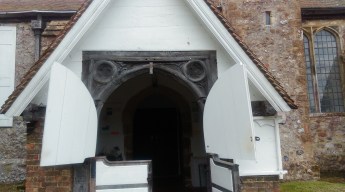
The church at Brooklands I have not seen this stable door arrangement on a church before

IMAG2836

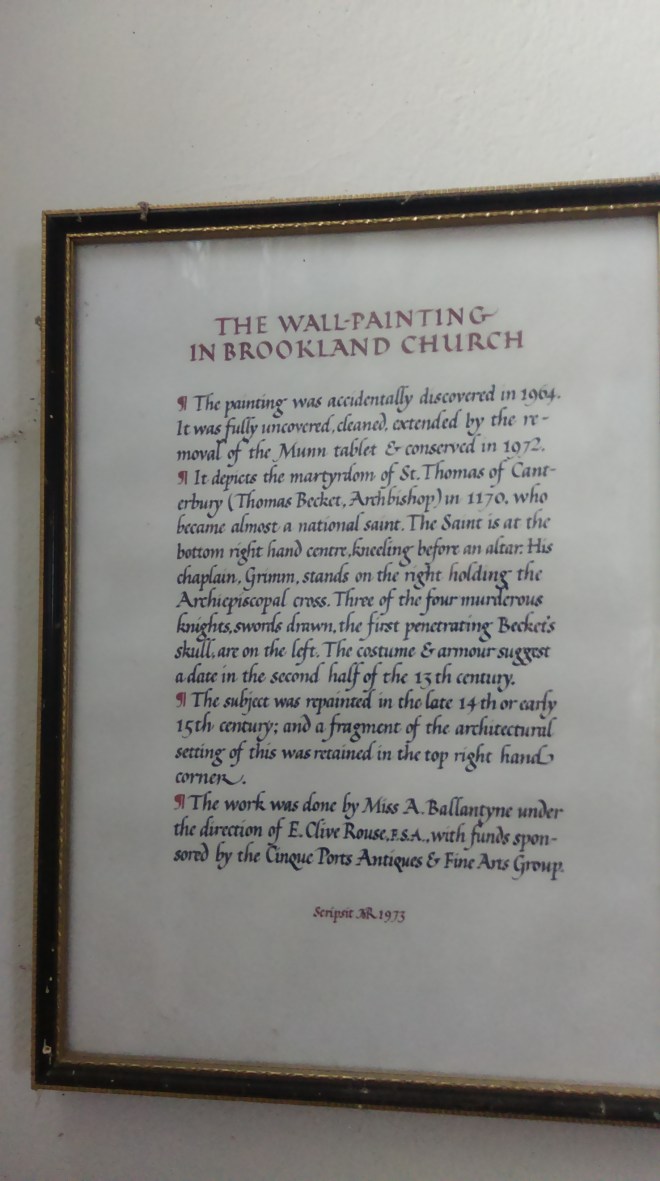
Owing to this, a number of churches have some nod to Thomas a Becket and here in  Brooklands on Romney Marsh, the church has a medieval mural of the martyrdom of Thomas a Becket. This is remarkable, not so much for the subject, but for the fact it has withstood the deprecations of both Cromwells Thomas and Oliver and the whole destruction of religious iconography that accompanied the reformation. Although to be fair it was covered up.

IMAG2830

IMAG2831

In addition the church has the most fantastic bell tower that is completely separate from the church and stands in the church yard. The tiles are wooden.

IMAG2821

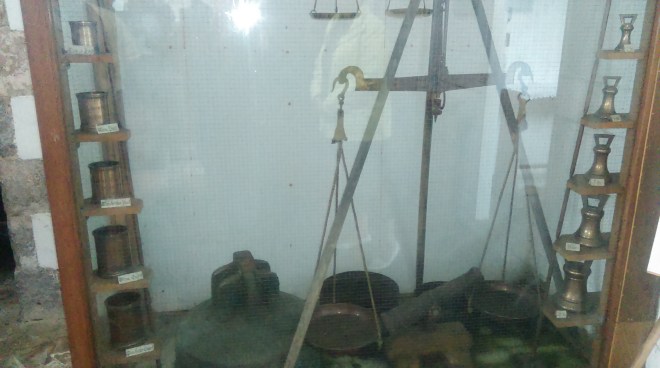
A reminder of the fact that a couple of hundred years ago everyone would have had to pay tithes a tenth of their crops to the church was found in these weights. This ensured the church received its due demands.

IMAG2827

As well as this I found a tomb of a sailor with a rather amusing epitaph.

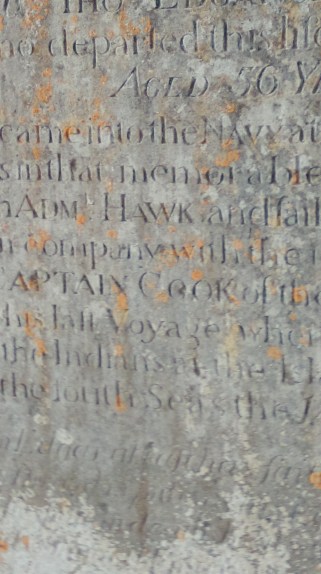
IMAG2866

In case you can’t read it I added the description.

IMAG2865

and a grave with a name I had never heard before. Gamaliel.

IMAG2825


It sounds like something from Lord of the Rings. I felt a bit ashamed of myself for judging those parents who name their children after trendy things the Paris, Morpheus, Tequila, Chardonnay, Mercedes and Sarumans of the modern generation. Obviously this is not a modern trend.

IMAG2828


Further on we found a lovely lead baptistry very heavy and  beautifully carved. I hope the church security is good. The lead was stolen from St Leonard’s in Wollaton last week again. Most churches in the area have replaced the lead with a less costly material. Indeed most of the lead on St Leonards was replaced  with an alternative material after the last theft.

IMAG2867

Most of the churches on the marsh had that smell of damp and mould and old hymn books. However the one in Hythe did not. It has a ossory where you can go and stare at the bones of dead people if you are so inclined. however having given myself nightmares over the one in Rome I wasn’t about to repeat the experience. The church was much lighter than many of the other ones and didn’t smell which was a relief. It was cool on a hot day and very quiet we wandered around enjoying the silence and the high roof.  The churches in both Rye and Hythe are massive indicating either a much larger population or a more devout community or alternatively a stopover for pilgrims on the way to Canterbury.

IMAG2868

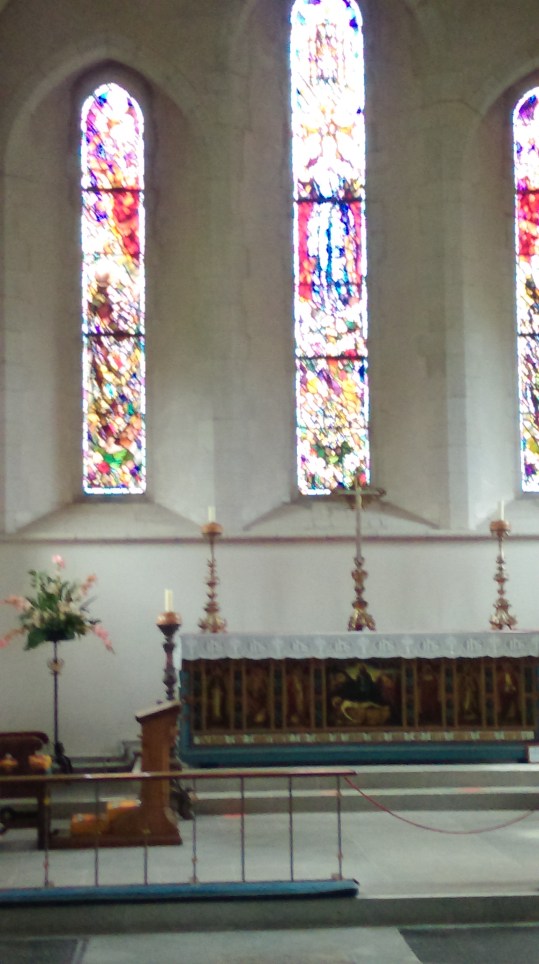
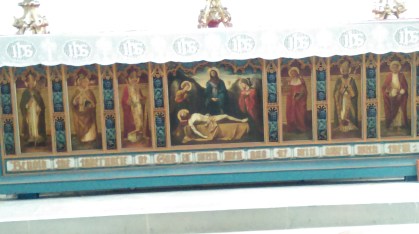
Here is details of the altar it seems a bit ornate compared to what I am used to. I preferred this simple chapel. I know in Rome the churches are full of lovely art and sculpture. However they. did not have the reformation.

IMAG2869

So this was our day for looking at churches I found it restful and interesting but I am glad that My favourite Geek prefers wildlife to old churches as I wouldn’t want to do it all the time. Thanks to the expert though I can now identify a Norman arch.


Lots of love your mother

A day on the Romeny, Hythe and Dymchurch railway.

We decided to forgo a visit to Folkestone and instead spent the day travelling the Romney Hythe and Dymchurch railway.

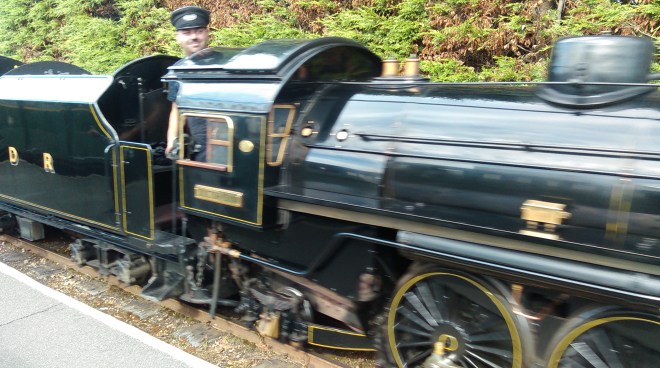
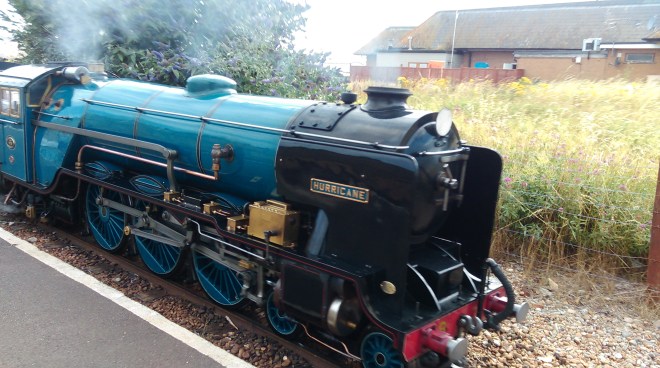
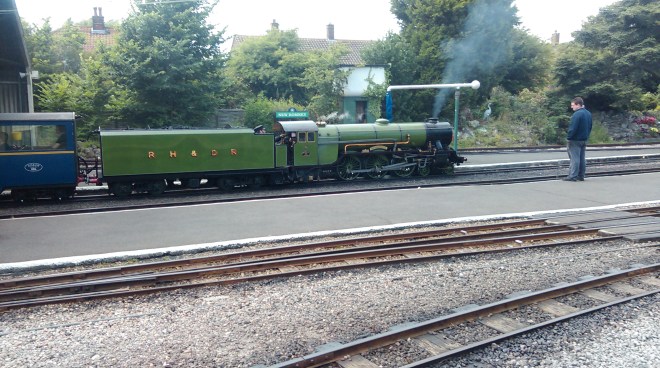
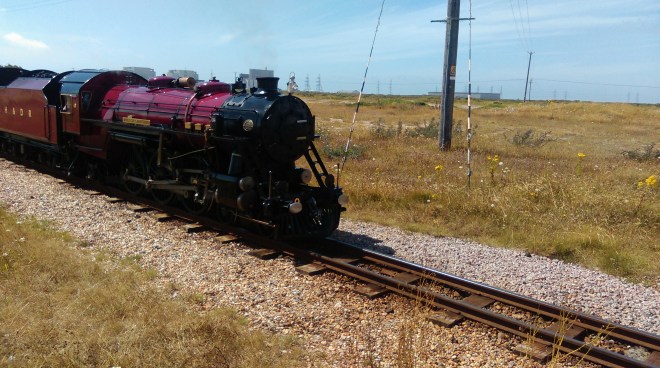
IMAG2889

Being married to my favourite geek he was in seventh heaven. we spent considerable time in the museum. We then photographed the trains.


IMAG2941

IMAG2932

IMAG2919

IMAG2908

IMAG2917

We watched the engines on the turntables  and photographed those.

The tracks are very narrow and it seems as if they are barely wide enough to accommodate the train. However apart from some jolts and noise it was a very smooth ride. We then photographed the tracks and the various carriages.  It was a rather windy day and Mr Geek lost his new hat owing to a particularly severe gust, we were travelling in an open carriage at the time.

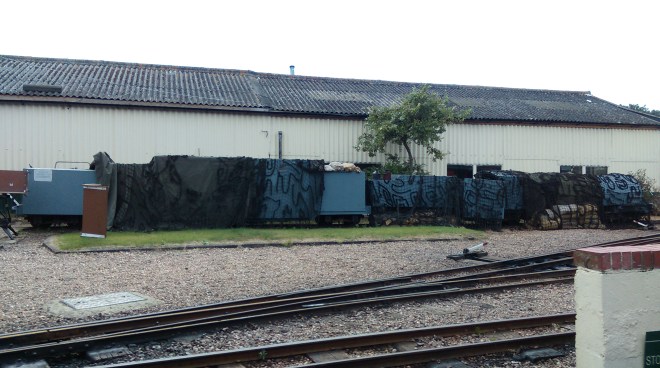
at the museum there was a train in camouflage that had been used during the war.

IMAG2898

We visited the model railway museum where Mr Geek was in heaven. Whilst enjoying the trains, I confess I was rather bored with the models, although judging from the numbers of children and their parents in the museum I was in a minority. Still I read a book in the corner whilst Mr Geek indulged his passion for all things mechanical.

We explored the sands at Romney Sands and saw our first waders feeding. I have to admit that this is the first ‘seaside ‘ resort where we haven’t seen many birds except the ubiquitous Herring Gulls. I found it disconcerting.

IMAG2871

We found some lovely plants and invertebrates at Dungeness, despite its bleak appearance it was full of plants and invertebrates. We also found a lovely pub that did spectacular fish and chips. In spite of being in the middle of nowhere this establishment was packed. This usually indicates it is a good place to eat and has a reputation. It did a spectacular lemon drizzle cake. So fortified we had a long walk before returning for the return journey on the train. When we returned to the hotel we had walked seven miles.

Hope you like the photos