The Return of Winter

How a day can change everything? Sunday it was so cold. In this country we certainly get all four seasons, but do we have to have them all in the same 24 hour period? The sky was grey and cloudy and a bitter lazy wind was blowing. A lazy wind cannot be bothered to go around you it merely passes through you. The five layers of clothing I was wearing offered me little protection from its chilly blast. As the weather looked so threatening we decided to go to Attenborough Nature Reserve.

Accordingly after a leisurely breakfast we pottered down in the car taking out scopes and bins. The area around the nature centre was packed with dog walkers, amongst them parents with pushchairs and toddlers small children on bikes and wheelchairs were everywhere. As we weaved our way in and out of the crowds an adult on a bike would hurtle past worrying me about the possibility of hitting a child.

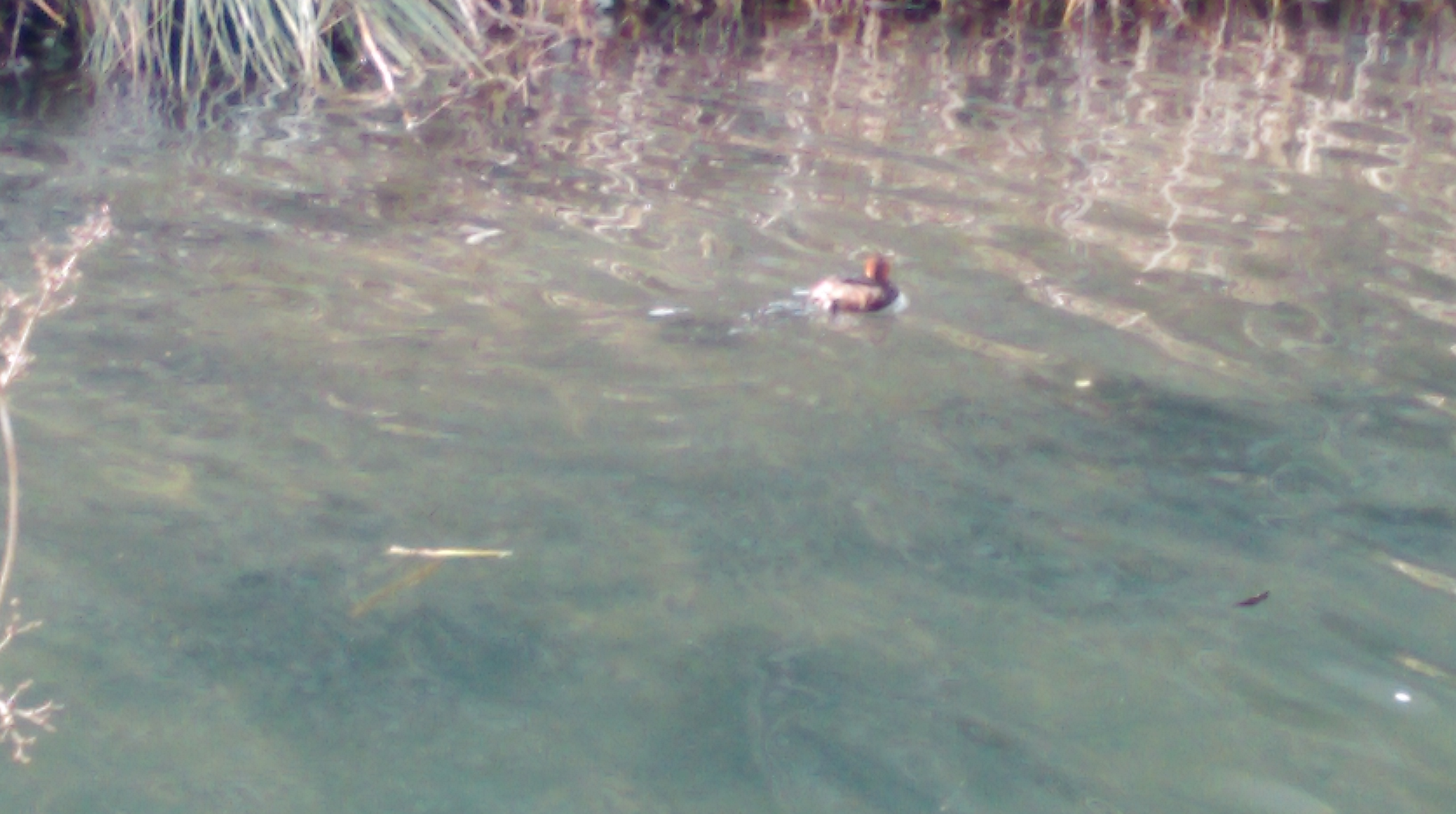
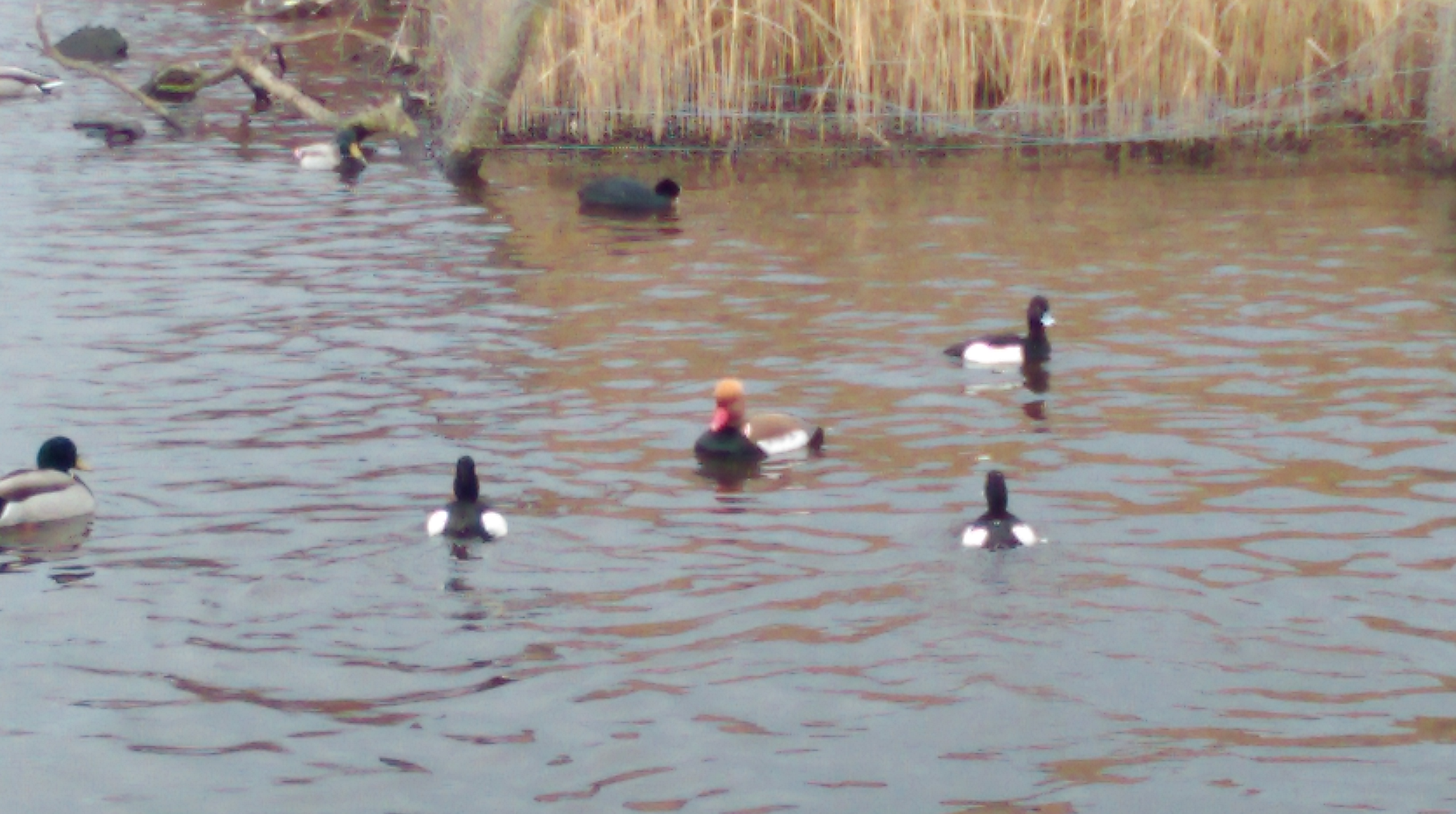
From the bridge near the nature centre, a Cettis warbler was singing. We stationed ourselves beside the bridge and stared fixedly at the reeds until we were rewarded with an excellent view of him, low in the reeds, clinging onto a reed stem, as he fanned his tail for support and sang so loudly you could hear it from the duck feeding area. That was a new sighting for the year. A couple of Red Crested Pochard males swam near the bridge to the nature centre another first sighting for the year.

IMAG0502

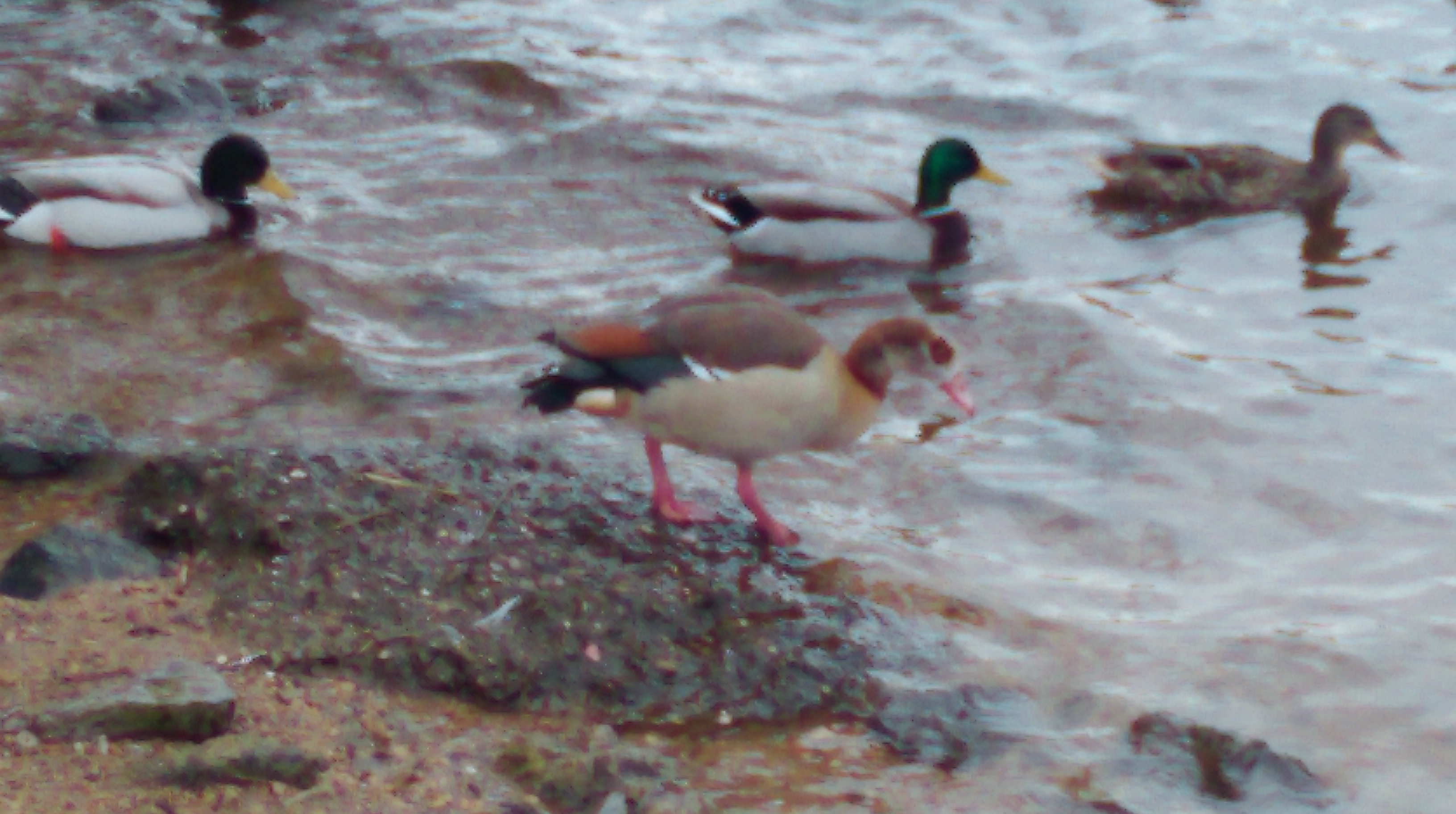
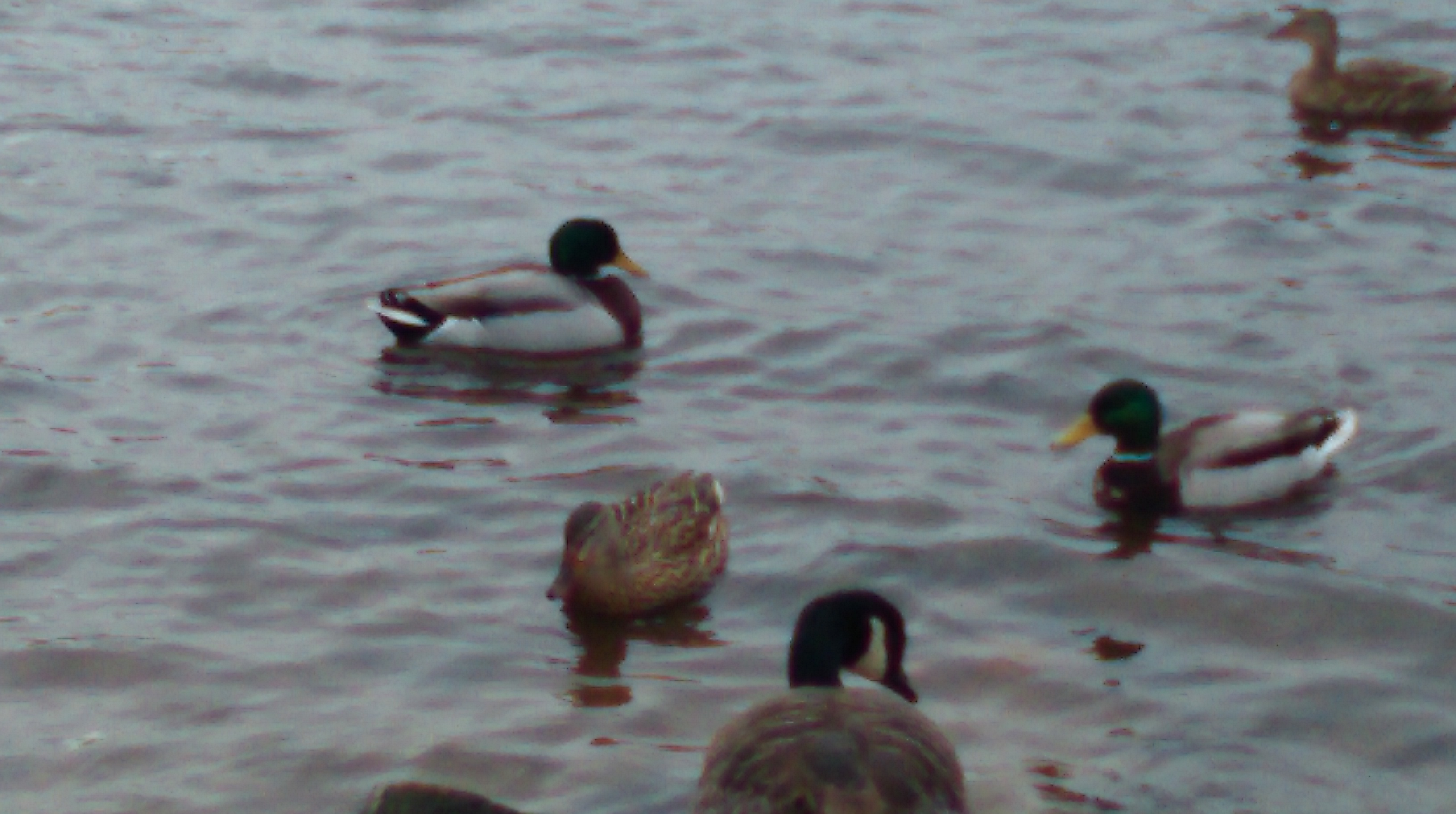
I photographed the Egyptian geese

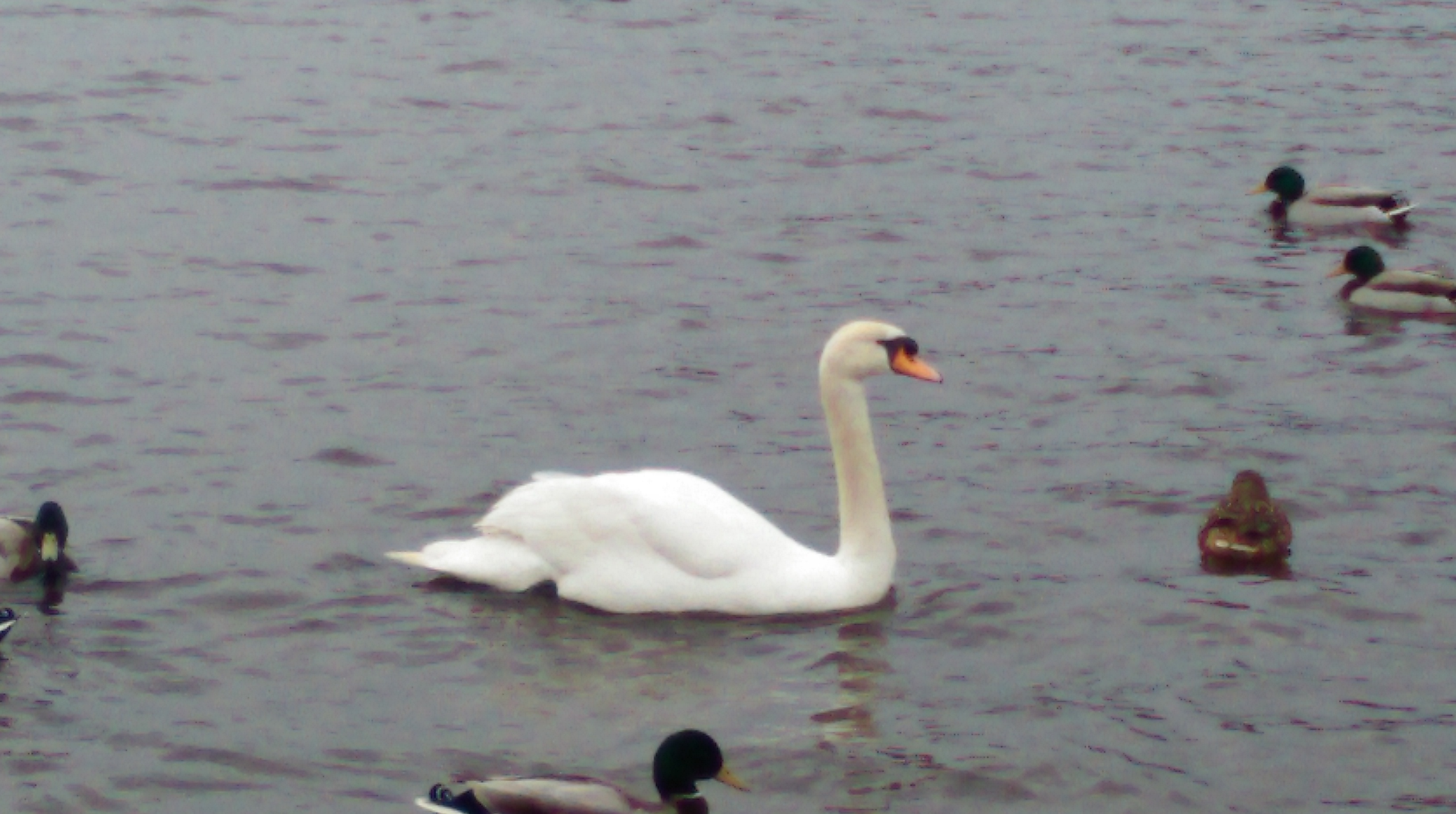
and the Pochard as well as a number of other ducks.

IMAG0498

IMAG0501 (2)

IMAG0499 (3)

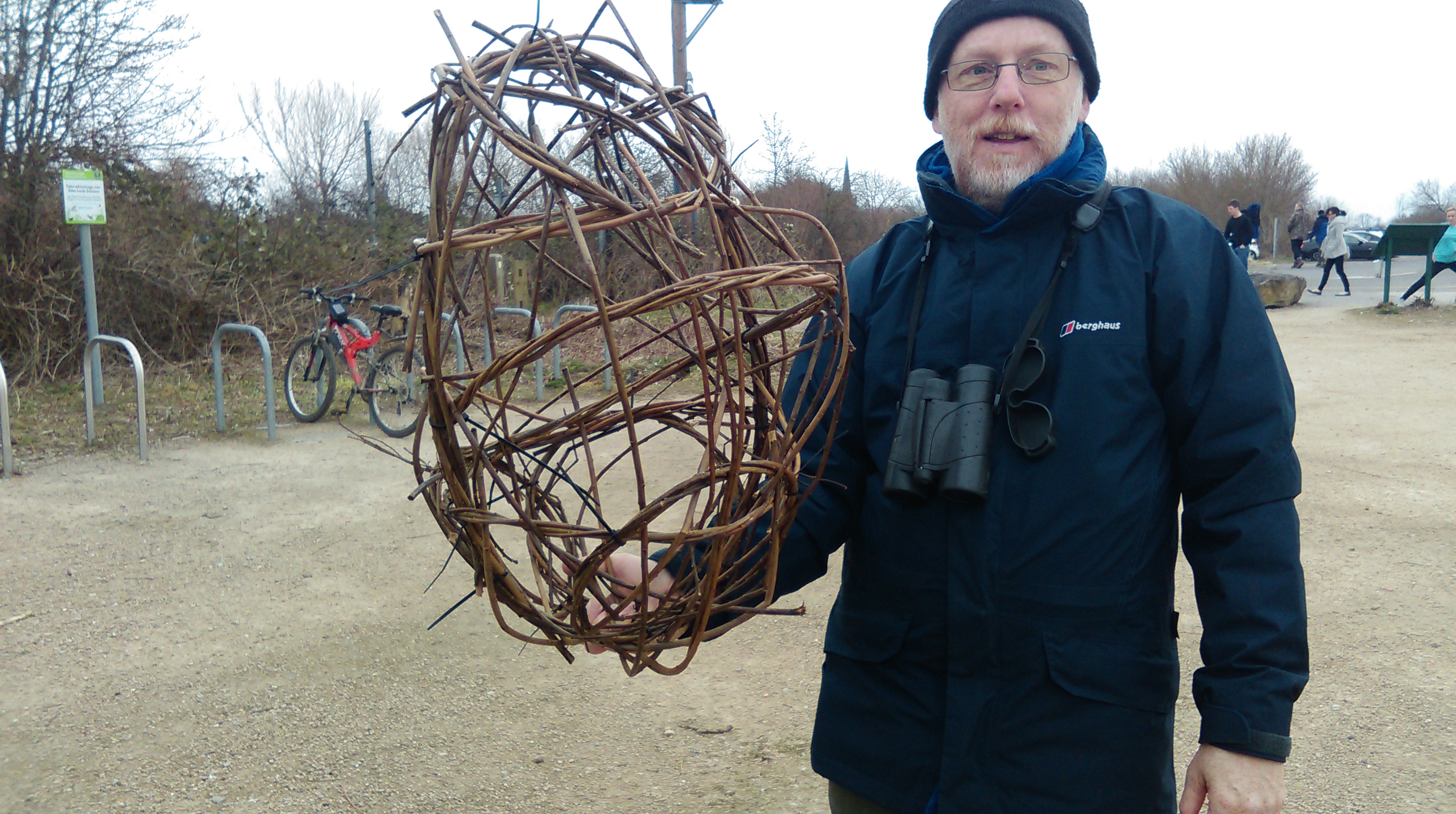
I then went to talk to a couple who have bravely set up a gazebo under which they were attempting to make willow sculptures. We briefly considered buying a willow bittern so we could plant it near the pond in the garden and then phone you with the news that a bittern was seen near our pond. Amusing as we found this idea we realised you would be considerably annoyed by our childish behaviour. Do you remember your response to the stone otters in Scotland and how angry you were that we had conned you?

IMAG0510

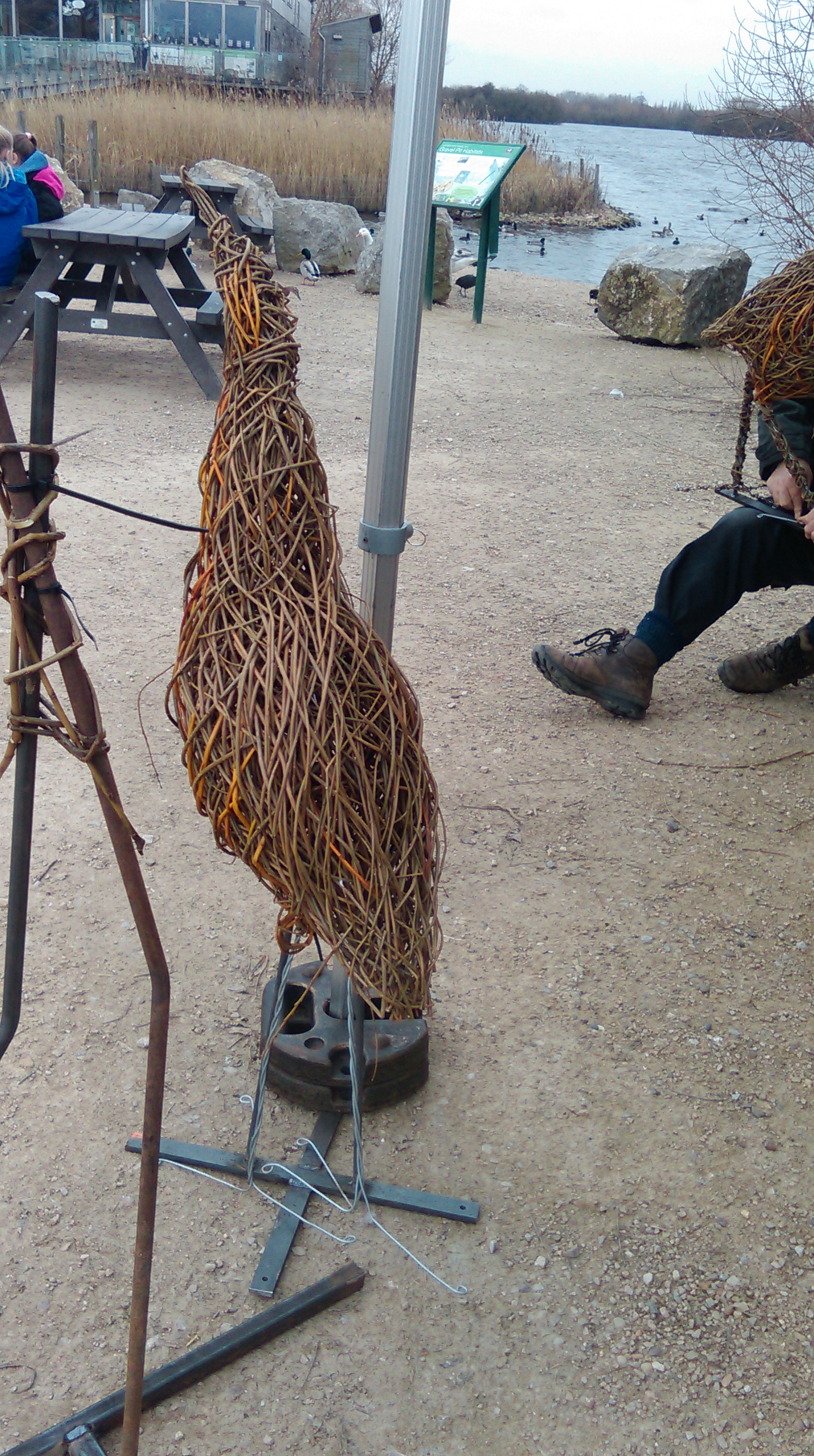
Anyway I spent some time making a willow heron. I found it quite enjoyable and relaxing. The heron did look as if he had just eaten a large meal once I had finished. Here is the heron when I left. I hope you have a vivid imagination as you will need it.

IMAG0508

From the hide we saw a very smart Redwing all the usual ducky suspects. We just missed a Water Rail in front of the hide and had all three common tit species on the tree. The feeders have been taken down as rats have become a problem. We found a flock of Fieldfare on the other side of the river Trent. One Fieldfare alone was in the Wheatear field.

IMAG0514

The  invisible fieldfare

The plumage he had was marvellous so pristine I am assuming he was on his way north to breed. Again too far away for a decent photo here is the one I took but not great. Perhaps birds can detect changes in air pressure that we are unable to detect, for as we reached the furthest point of the short circuit it began to rain not particularly heavily but with determination. We were so far round that to return was as tedious as following the circuit.

Therefore we pressed on I found an elder bush in leaf.

IMAG0519

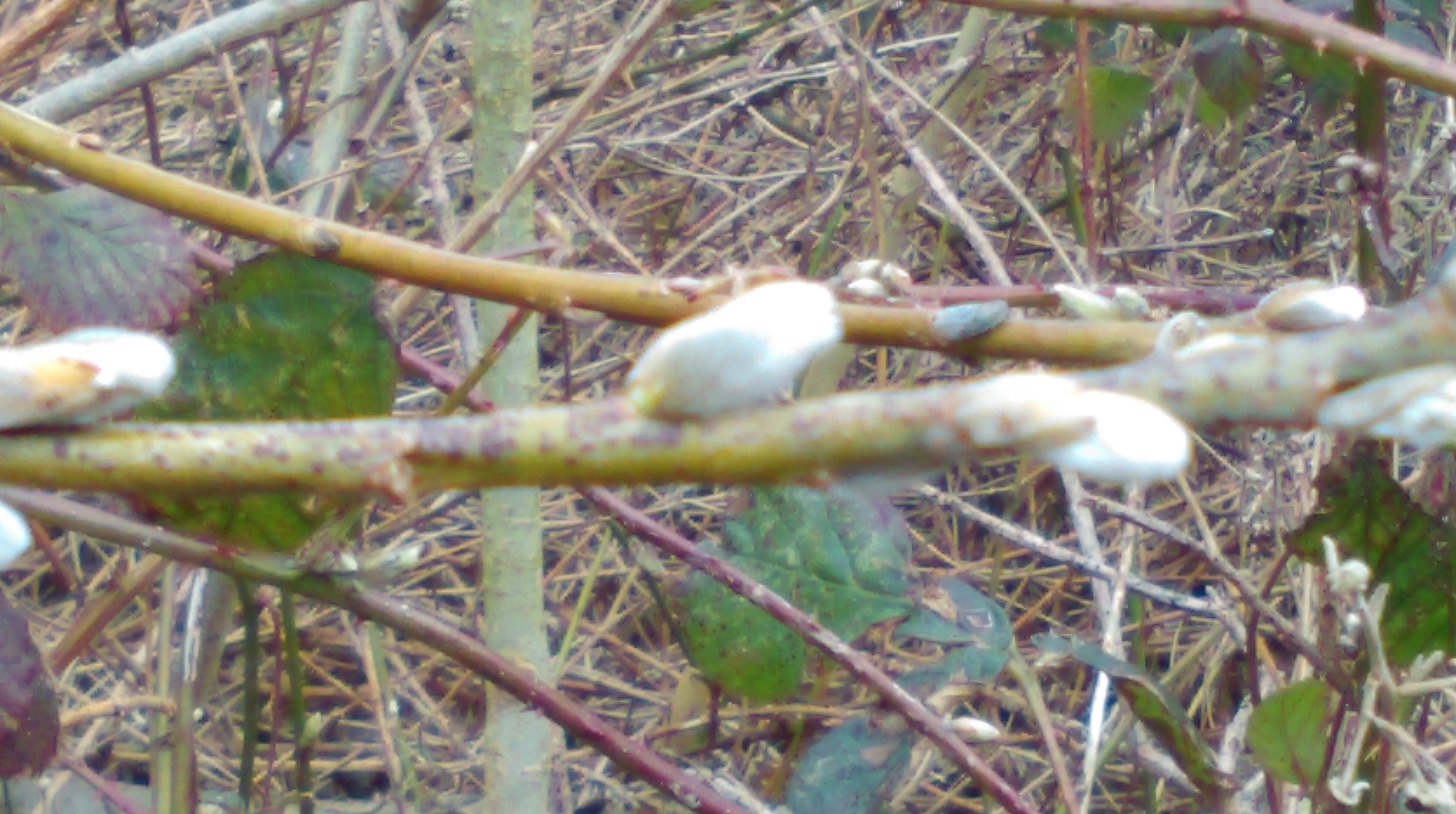
Likewise I saw willow buds just breaking.

IMAG0516

Along a hedge the blackthorns were just beginning to show the white of the blossom in their buds. Within a week or two they will be a mass of white blooms. We met someone who had seen brimstone butterfly, alas no butterflies fluttered for us. The rain increased persistently, although the wind had abated, we were both getting damp and chilled. The reserve was now deserted. We walked back to the nature centre alone on the path, no dogs snuffled around our ankles, no children crashed into us on their bikes we were able to stroll down the path as we pleased, there were no pushchairs to avoid, no speeding cyclists to endanger us and no dog leads to trip us up. I fully expected to see tumbleweed blowing through. It was amazing how a shower can clear a nature reserve. I called past the willow sculptors and put more willow twigs into the heron, which was looking rather chubby and not the svelte shape drawn on the plan. I made most of the back end.

“What did you do today mummy?”

“I made the backside of a heron dear.”

We bought a calendar for work each from the shop and came home for a hot lunch.

We had taken over two and a half hours, seen 49 species and two that were new for the year.

February the cruellest month

IMAG0289

Someone once called February the cruellest month. Whilst the weather this year is not dreadful for someone who anticipates the first signs of Spring it is a long wait.

IMAG0263

The first signs that spring is on the way are the birds. Even though it is still dark when I leave the house in the morning there is sound from every conceivable perch and vantage point. Great tits, robins, dunnocks, and a song thrush shout about their sexual availability and warn any rivals to vacate their territory. Once I arrive at work mistle thrushes rattle over the car park. A family of long tailed tits frequently search the silver birch trees, whilst a community of robins and dunnocks skulk under the bushes. During the day various species of gull land on the field and stamp around trying to encourage the worms to come to the surface. Occasionally a buzzard flies in and settles on the grass. A family of magpies haunt the bins on the paving outside as pied wagtails strut their stuff outside the building. One memorable afternoon I looked out to find a grey wagtail a few feet from the window seemingly unconcerned with the presence of people.

Funniest of all was the grey squirrel I see most mornings perched on the bin and eating scraps whilst the pieces he discards are pounced upon by a family of magpies gathered in a circle around the bins. By the time I drive home it is dark consequently it is the middle of the month before I realise that a transformation has begun in the garden the snowdrops are in flower.

GetAttachment 5

There are clumps in every bed some doubles and others the native ones. The catkins are present in the hazel tree shedding pollen as I tap them. I have to search to find the female flowers which are so much smaller.

IMAG0450

IMAG0475

We went for a drive at the weekend and found a patch of winter aconites beside the road near Kilington. We had been to see the great northern diver. The aconites were mixed with snowdrops. I photographed them for you.

IMAG0288

IMAG0290

For me they were a reassurance that spring is on the way and winter will not last forever.

IMAG0259

Your loving mother

February The Cruellest Month

Someone once called February the cruellest month. Whilst the weather this year is not dreadful for someone who anticipates the first signs of Spring it is a long wait. The first signs that spring is on the way are the birds. Even though it is still dark when I leave the house in the morning there is sound from every conceivable perch and vantage point. Great tits, robins, dunnocks, and a song thrush shout about their sexual availability and warn any rivals to vacate their territory. Once I arrive at work mistle thrushes rattle over the car park. A family of long tailed tits frequently search the silver birch trees, whilst a community of robins and dunnocks skulk under the bushes. During the day various species of gull land on the field and stamp around trying to encourage the worms to come to the surface. Occasionally a buzzard flies in and settles on the grass. A family of magpies haunt the bins on the paving outside as pied wagtails strut their stuff outside the building. One memorable afternoon I looked out to find a grey wagtail a few feet from the window seemingly unconcerned with the presence of people.

Funniest of all was the grey squirrel I see most mornings perched on the bin and eating scraps whilst the pieces he discards are pounced upon by a family of magpies gathered in a circle around the bins. By the time I drive home it is dark consequently it is the middle of the month before I realise that a transformation has begun in the garden the snowdrops are in flower.

Walking at Rufford looking for hawfinches I took some shots of the snowdrops

IMAG0410

Tthere are clumps in every bed some doubles and others the native ones. The catkins are present in the hazel tree shedding pollen as I tap them. I have to search to find the female flowers which are so much smaller.

IMAG0453

IMAG0474

We went for a drive at the weekend and found a patch of winter aconites beside the road near Kilington. We had been to see the great northern diver. The aconites were mixed with snowdrops. I photographed them for you.

IMAG0287

For me they were a reassurance that spring is on the way and winter will not last forever.

Your loving mother

March comes in like a lion

March comes in

like a lion

Last Saturday felt like the first day of spring. The temperature was a balmy 15 degrees centigrade. The sky was a baby blue with small scudding clouds that passed swiftly overhead and for the first time this

year the sun warmed the back of your neck if you stood for a few moments. We decided to walk along the Cromford canal from the mill along to past the bridge on the river, retracing our steps once we had walked enough.

IMAG0393

IMAG0376

Next to the mill a rather aggressive swan was seeing off a pair of Canada geese.

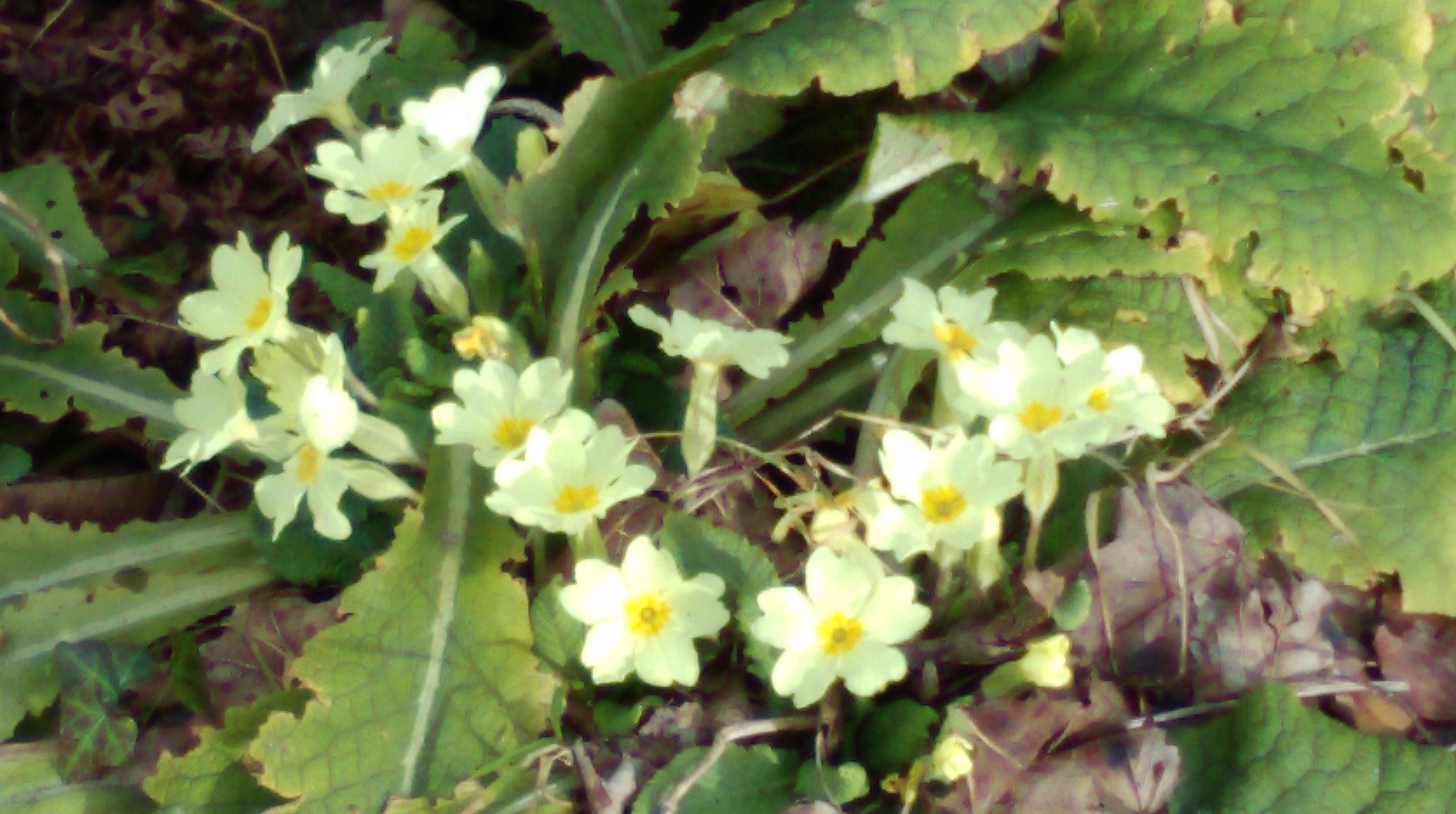
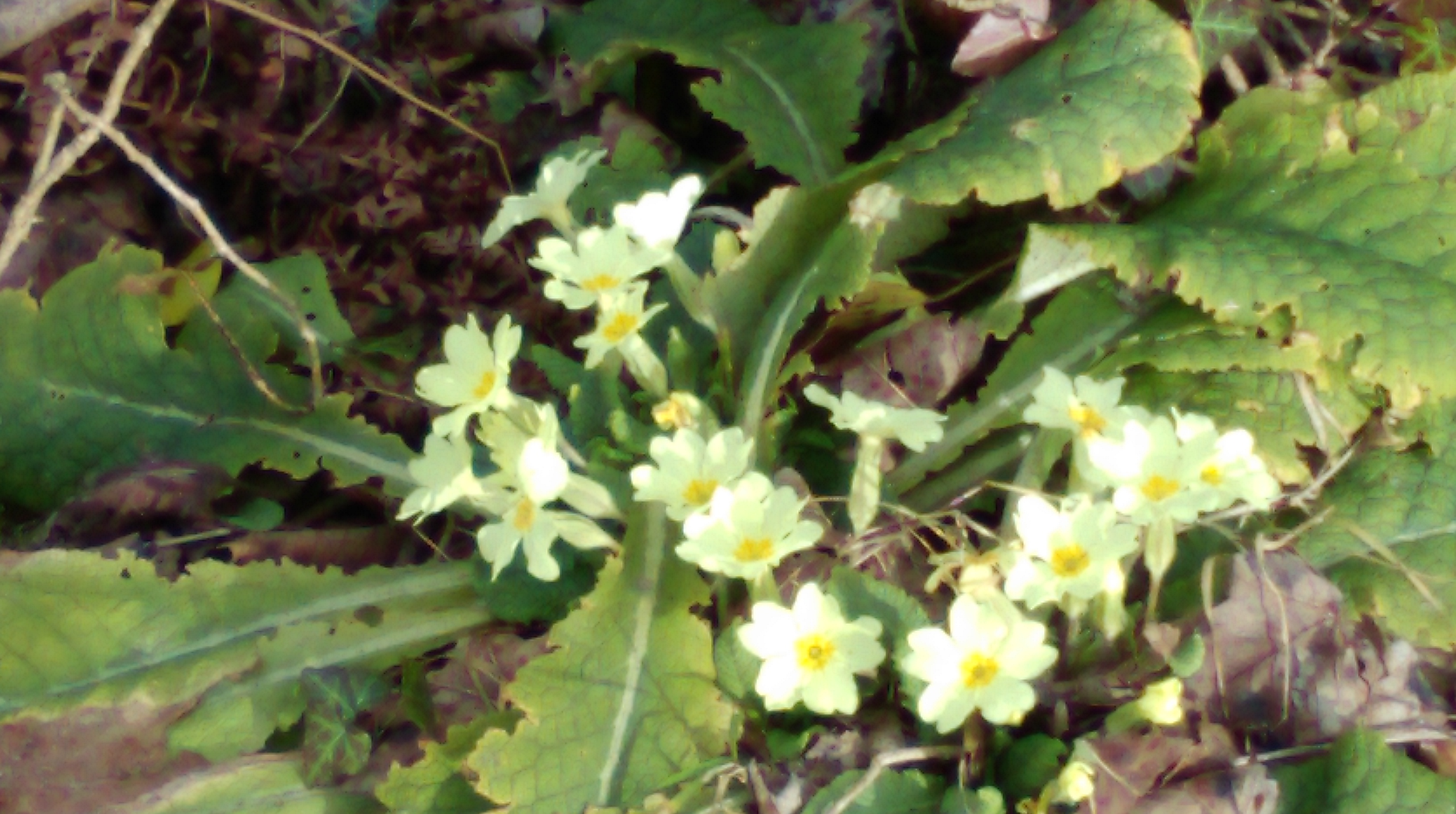
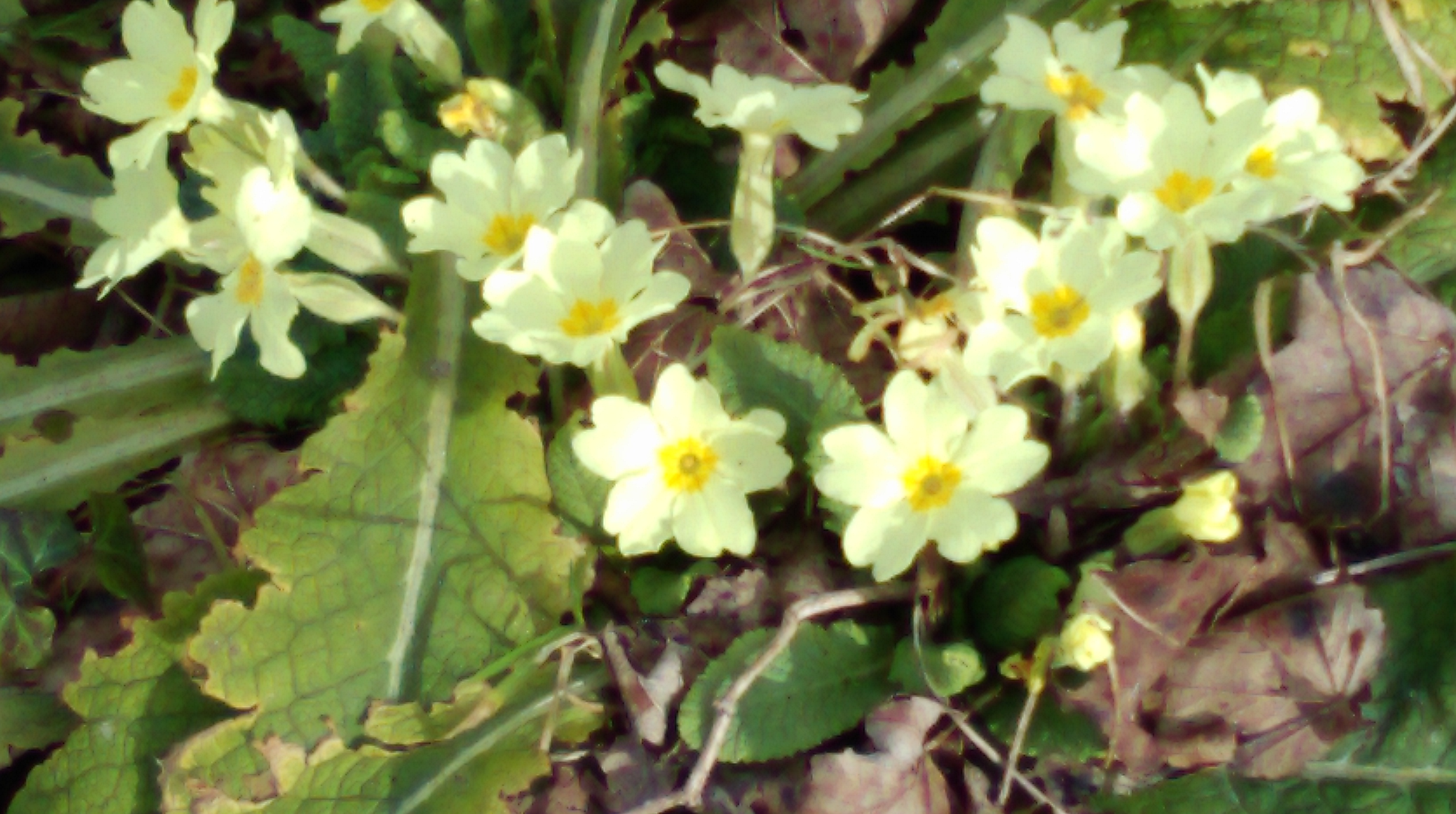
We meandered slowly along noting every bit of wildlife we could find. There were so many indications of incipient spring. We found a clump of primroses ( Primula vulgaris)beside the track.

IMAG0371 IMAG0372 IMAG0373

A little further on we saw the first coltsfoot (Tussilago farfara) just the flower visible not the leaf. Once the sun came from behind a cloud the flower opened fully it was dazzlingly bright against the muted colours around.

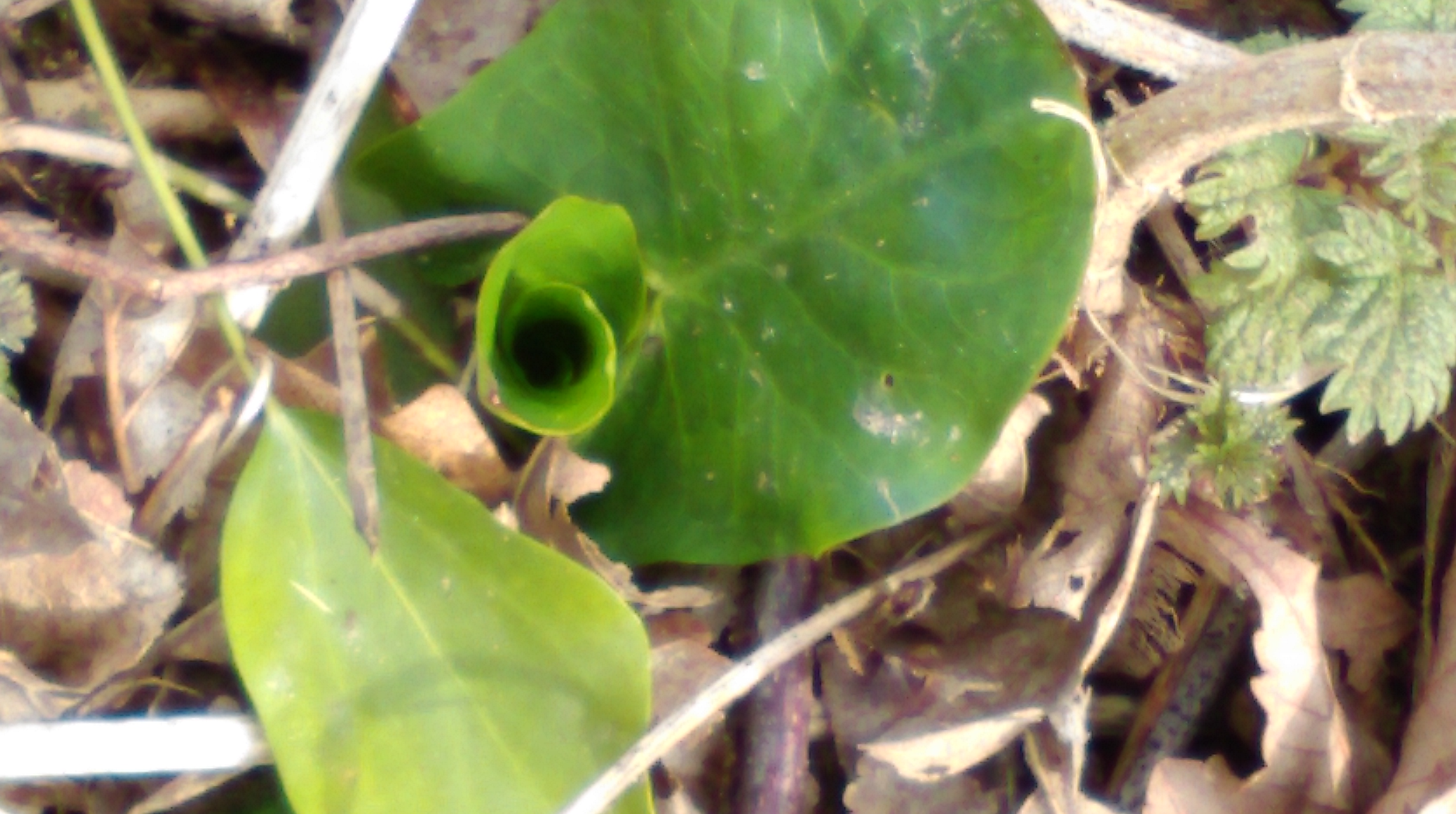
Wild arum also called cuckoo pint (Arum maculatum) was beginning to show leaf in the bottom of the woodland.  Wild garlic or ransomes (Allium ursinum) was just showing the tip of its leaves.

IMAG0355

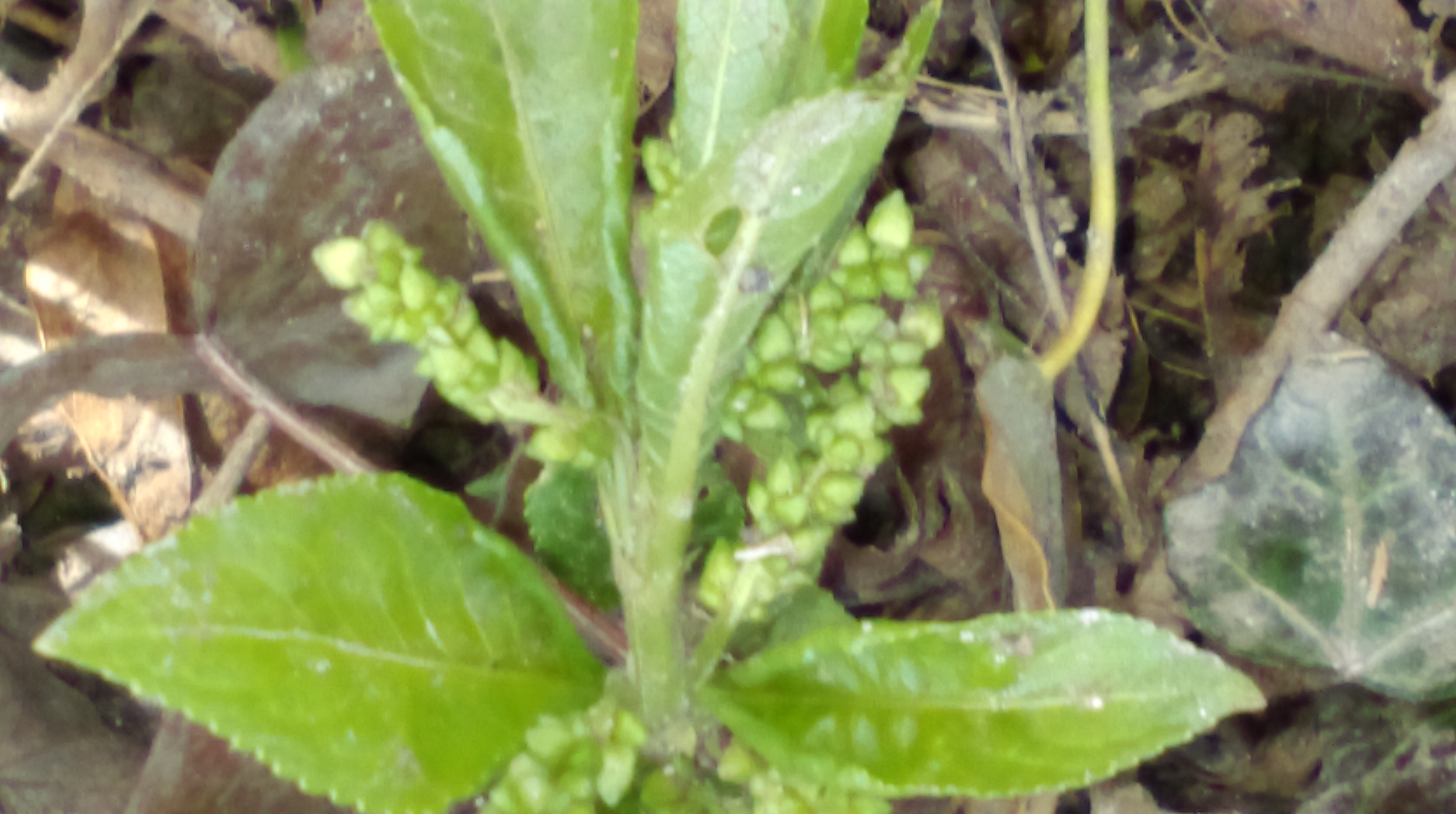
A little way down the track I found some Mercurialis perennis  or dog’s mercury growing this plant is an indicator of ancient woodland thus I assume the wood beside the path must be quite old.

IMAG0350

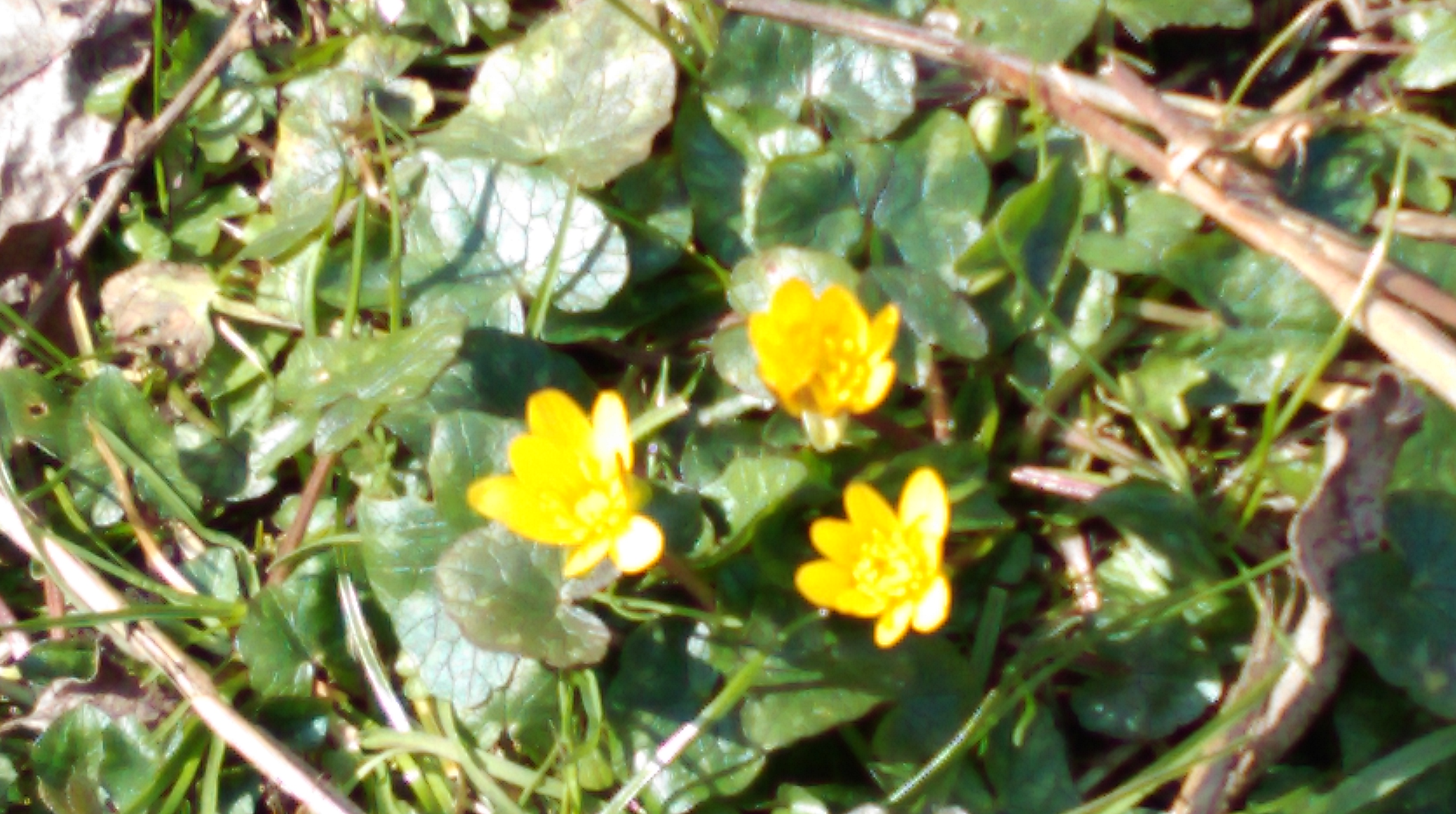
As we walked along we noticed several clumps of lesser celandine (Ranunculus ficaria) beside the path. These were the first ones I had seen in flower this year. Again the contrast between the flower when the sun was hidden and the flower when the sun was out was amazing.

IMAG0423

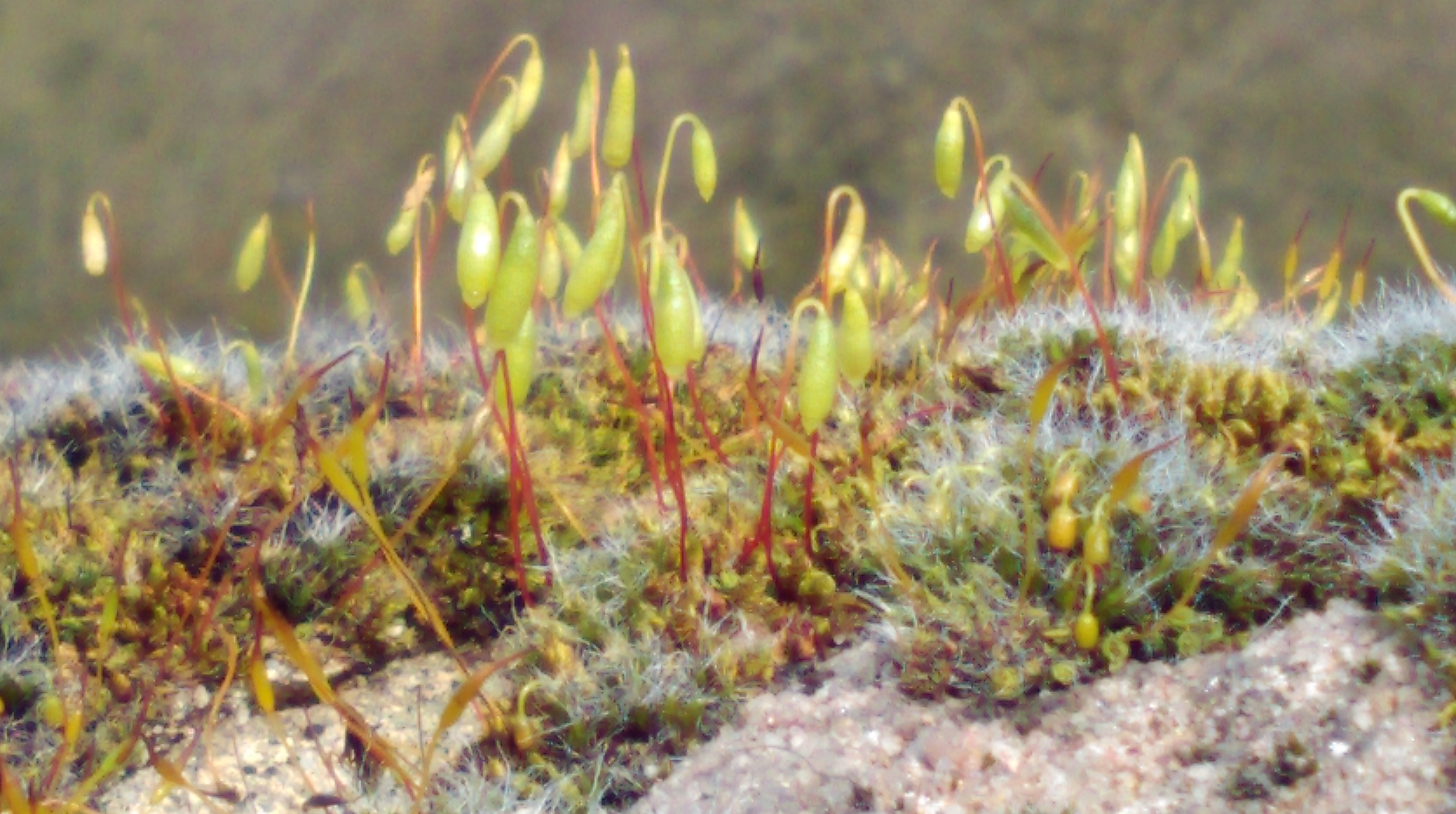
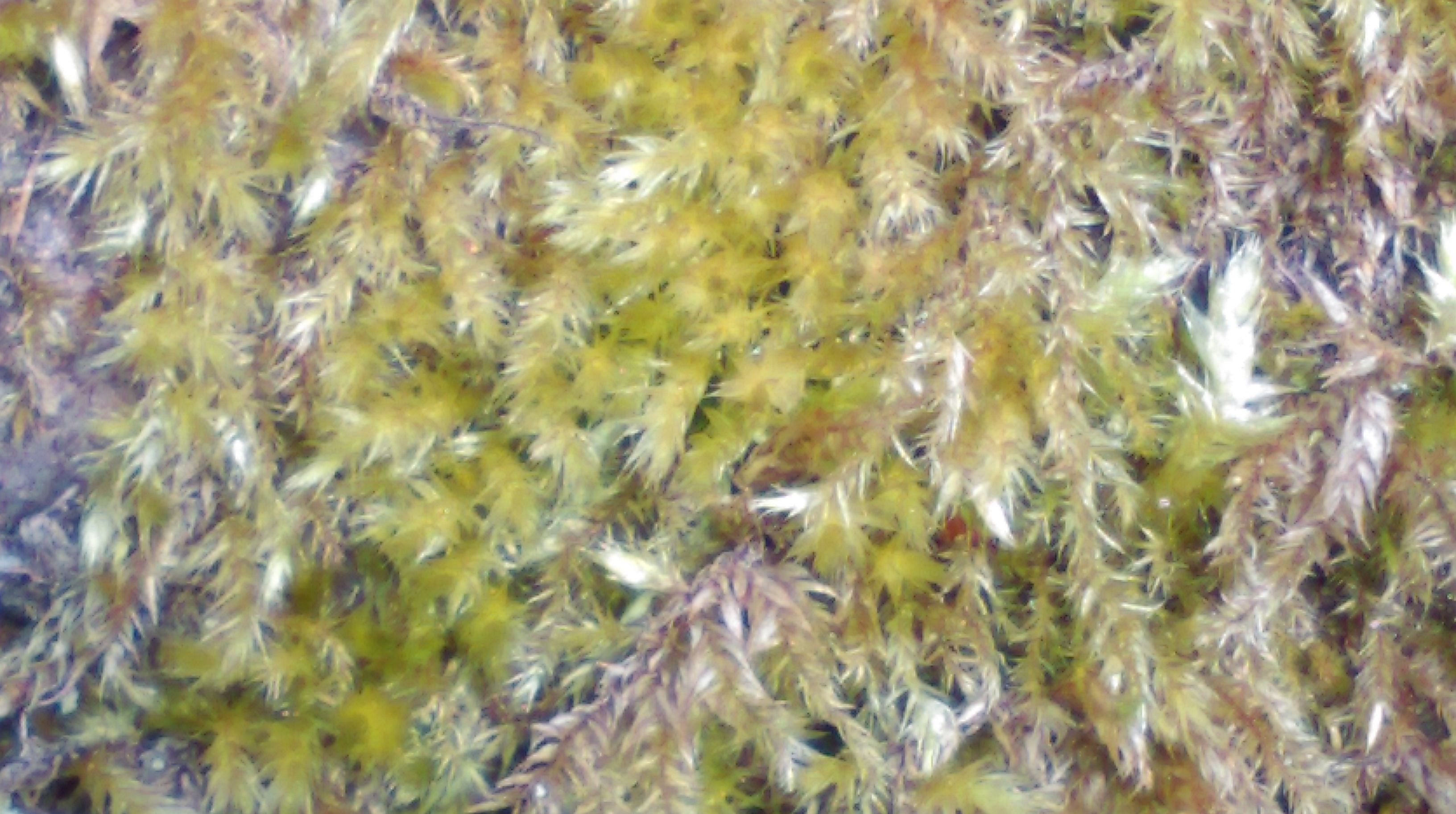
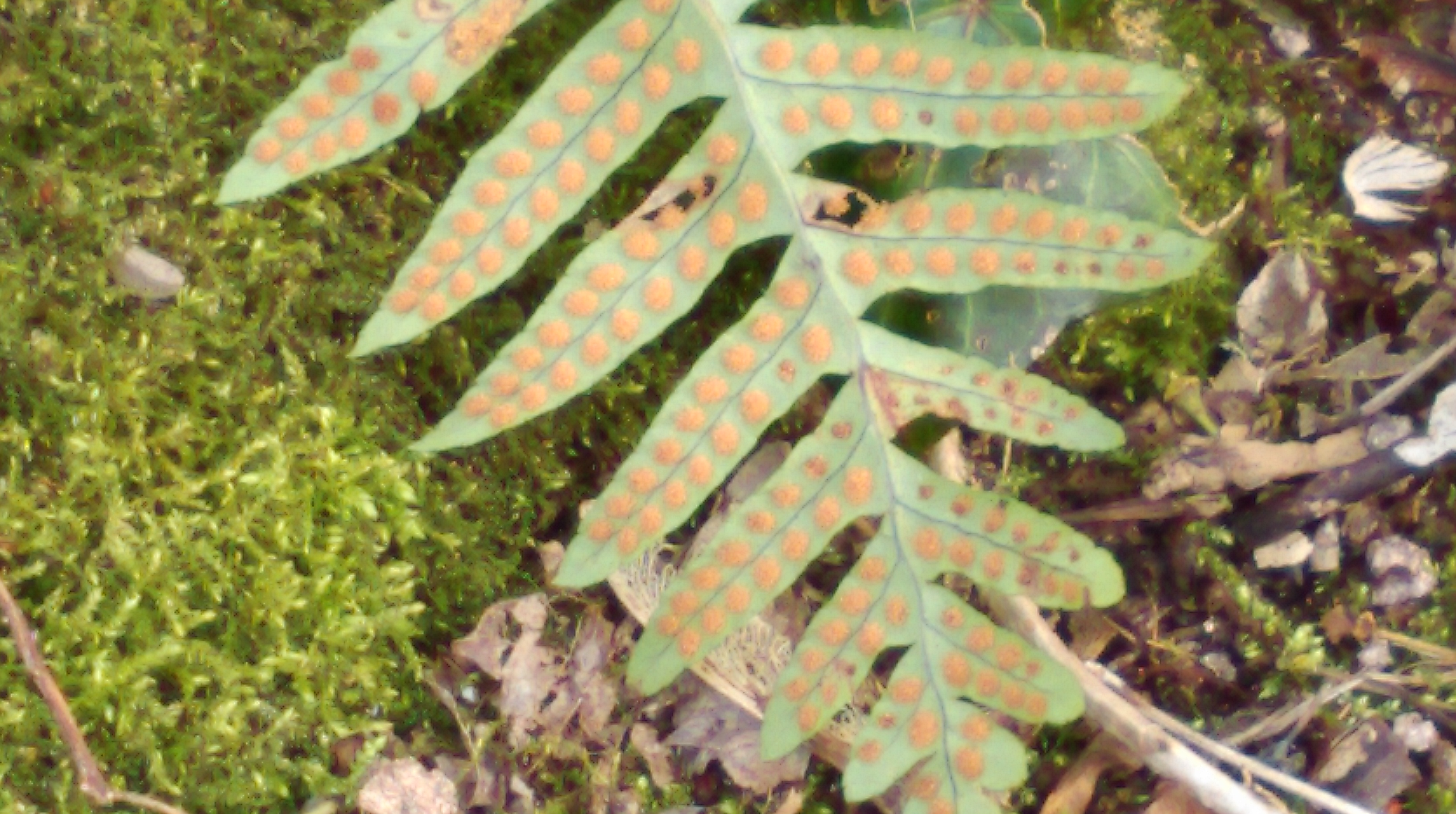
I discovered that the camera on my mobile takes good close up shots so I took a lot of close up photos of ferns mosses and lichens.

IMAG0391

IMAG0375

IMAG0343

IMAG0344

There were catkins on some of the trees these ones were alder catkins and I found a female flower although it is

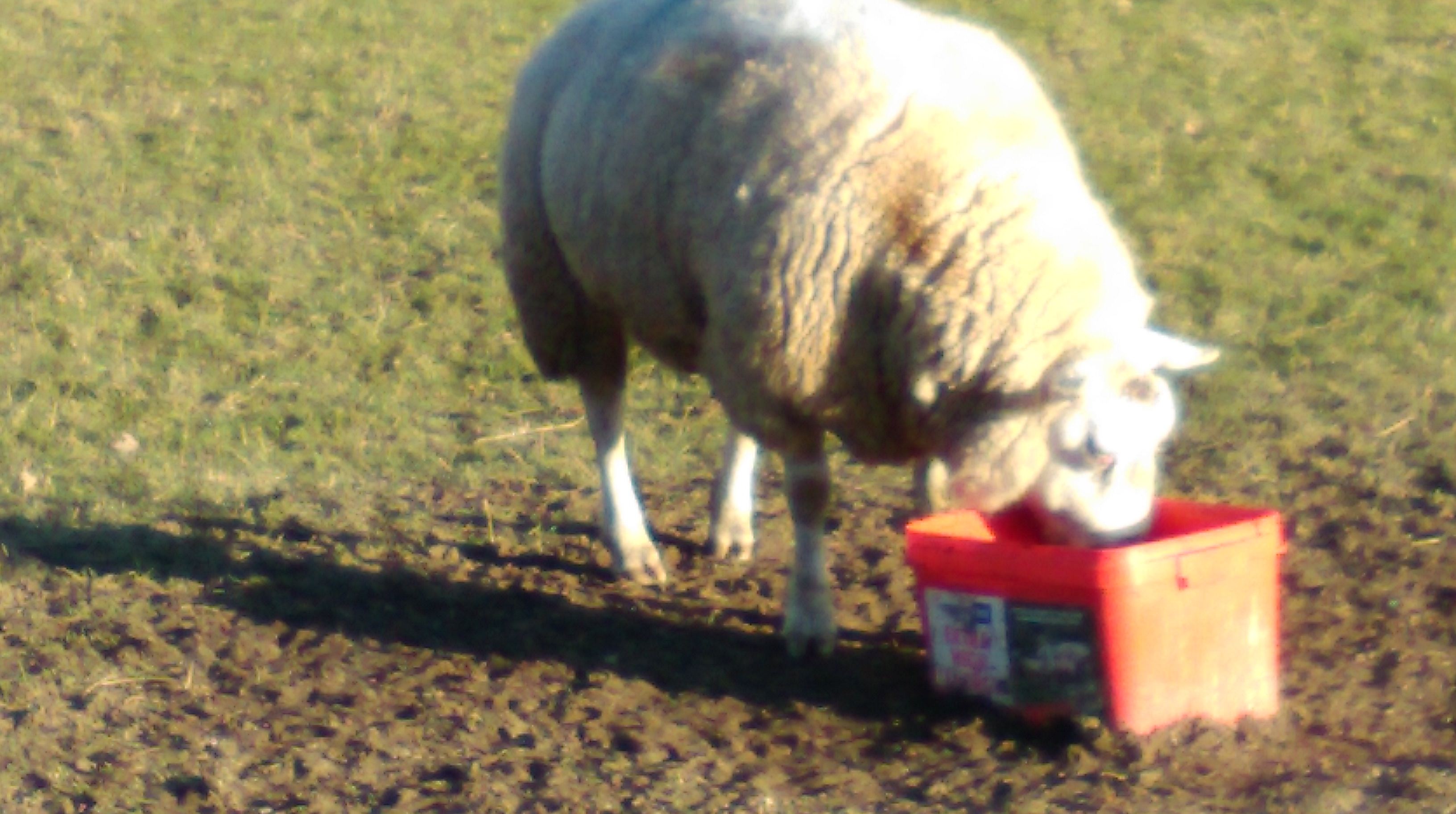
so bright it is also minute and consequently easily overlooked. The sheep here must lamb later than in some areas as they

were all pregnant still, looking a bit miserable about it all.

IMAG0477

We had lovely views of grey wagtail here is one in a tree if you can spot the bird in this photo I will be impressed.

IMAG0425

A robin sat for quite a few minutes in this tree giving us a performance. Although I am conscious that this call is merely to advertise his sexual prowess and to defend his territory from rival males, it was rather glorious in spring sunshine.

IMAG0357

Three pairs of little grebes had set up territories along the canal. They really are the most frustrating birds to photograph. I would see them sitting near the bank as I snuck up on them. Then as I got within range they would wait until I was just about to take the shot then dive coming up under tree roots on the far bank. I have quite a few shots of ripples with no little grebe visible.

IMAG0341

IMAG0368

If they were not so attractive I would have given up trying. It was like being at a firework display trying to take photos of the fireworks and being just that split second too late. The river was high and although we lingered by the bridge we did not see any dippers.

IMAG0394

THE INVISIBLE GREY WAGTAIL

It was such a lovely day that we went on to Carsington water where we saw the Great Northern Diver at some distance and still in winter plumage. There were a pair of willow tits on the bird feeders too quick for me to photograph. The reserve has an impressive flock of over 30 tree sparrows. They appear to do everything together possibly a strategy to avoid

predators. Every few minutes all of the tree sparrows would land simultaneously on a bird feeder where they would frantically eat the seed scattering as much as they ate. Suddenly for no apparent reason they would all fly away back to

the trees moving as if they were a single organism.

A flock of barnacle geese were among the Canada geese. Couple of collared doves frequented the feeders keeping a close watch as they fed. We completed our day with a walk along the river at Grindleford where try as we might we could not

find a dipper. We came home along the back roads over Froggatts Edge. We passed o a narrow road that wound up and down steep valleys passed moorland fields wth stone walls and copses. The sun was low enough in the sky to cast long

shadows and produce that golden quality of light so beloved of filmmakers. A frmer had spread a load of manure over one field. As a result every corvid for miles around had converged on this field with calls of delight. They were all

frantically digging their beaks into the black smelly mess looking for invertebrates. It is strange that a substance so repellent to us should be the source of so much delight to them.

I know I am anthropomorphising, but they appeared to relish their actions. We failed to see a raven despite the hundreds

of corvids present. It was a truly marvellous day

Weed of the Week Impatiens glandulifera Himalayan Balsam

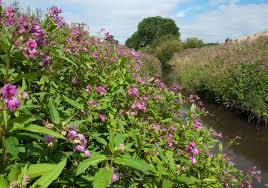
Impatiens glandulifera Himalayan Balsam hymalayan balsaM flower 2 Himalayan Balsam, Impatiens glandulifera (also known as Indian Balsam, Jewelweed, kiss-me-on-the-mountain, Policeman’s Helmet) is a tall, herbaceous, annual flowering plant in the Balsaminaceae (balsam) family. The common names Policeman’s Helmet, Bobby Tops, Copper Tops, and Gnome’s Hat stand all originate from the flowers being decidedly hat-shaped. Himalayan Balsam and Kiss-me-on-the-mountain arise from the plant originating in the Himalayan mountains. It native range extends from the east Asia to the western Himalayas and south to Pakistan, it has, however, been naturalized in Britain and the USA. In its native habitat it is most typically found in shrubberies and bushy places and is often associated with grazing land.

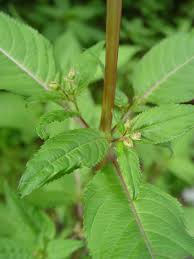
STRUCTURE himalayan balsam leavesThe plant is an annual, classed as succulent and glabrous (smooth and hairless) and is very hardy. Impatiens glandulifera germinates in February to March. A period of chilling at 4º C for over 45 days is necessary to break seed dormacy. Germination is epigeal and occurs relatively early giving seedlings an advantage over other plants as long as they are not exposed to frost. After 12 days the first lateral roots emerge and by 18 days these roots, the radicle, and hypocotyl greatly elongate. Within four weeks the testa is lost and the cotyledons become photosynthetically active. The first true foliage emerges as a whorl of 4 leaves, with subsequent whorls of 3. Seed sets occur about 13 weeks after flowering (Beerling & Perrins, 1993; NWCB, 2007).Typically the plants grow between 1 and 2m tall with a soft green or red-tinged stem, and lanceolate leaves 5 to 23cm long. The leaf margins are sharply serrate with 20 teeth, or more, along each side. Each leaf has a stout petiole (stem), with small, glandular stalks found at the base of these petioles. When crushed, the leaves have a strong musty smell. The flowers develop between June and October and these are pink, with a distinctive hooded shape. They are typically about 3cm tall and 2cm broad and each plant develops several solitary flowers on an elongated axillary stalk.

hymalayan balsam flower

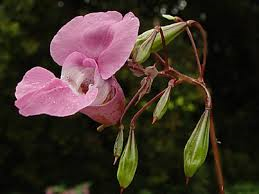
Individual plants reaching 2m in height, have translucent fleshy stems, pink-purple slipper-shaped flowers and large oval pointed leaves with obvious teeth around their edges. Each tooth carries a small globular ‘gland’ and produces large numbers of flowers which are followed by typically five chambered‘seed pods’ about 25mm long and 8mm broad.

hymalayan balsam seedpods

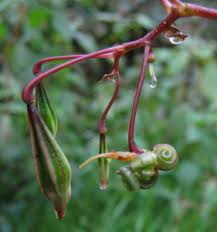
When mature and dry, the fruits split open explosively if touched, flinging the seeds a considerable distance (up to 7 metres) from the parent plant. After pollination (the flowers are very attractive to bees), the seed pods form. The seeds are small (2 to 4mm) and teardrop shaped. They range from very pale when immature through green to almost black when ripe.

hymalayan balsam seeds

The ripe seeds are light and float on water. When crushed the foliage emits a strong musky scent. Indeed, the name Impatiens (impatient) refers to this seed dispersal method. . The species name glandulifera comes from the Latin words glandis meaning ‘gland’, and ferre meaning ‘to bear’, in that the plant has glands that produce a sticky, sweet-smelling, and edible nectar. HISTORY IN THE UK In the UK the plant was first introduced in 1839 at the same time as Giant Hogweed and Japanese Knotweed. These plants were all promoted at the time as having the virtues of “herculean proportions” and “splendid invasiveness” which meant that ordinary people could buy them for the cost of a packet of seeds to rival the expensive orchids grown in the greenhouses of the rich. Within ten years, however, Himalayan balsam had escaped from the confines of cultivation and begun to spread along the river systems of England. Today it has spread across most of the UK and some local wildlife trusts organise “balsam bashing” events to help control the plant. However, a recent study (Hejda & Pyšek, 2006) concludes that in some circumstances, such efforts may cause more harm than good. They are now classed as an invasive species as their rapid growth and easy spread means that they easily out-compete native plants, particularly on disturbed ground, cleared ground and riverbanks. The small size of the seeds, the explosive nature of the seed pods and the buoyancy of the seeds means that they are easily distributed, particularly if growing by streams and riverbeds. The species is particularly frequent along the banks of watercourses, where it often forms continuous stands. It can also establish in damp woodland, flushes and mires. It is the tallest annual (species of plant that completes its life cycle in one year) in Britain and due to its rapid growth, it shades out most of our native species. Each plant produces about 2,500 seeds which fall to the ground, and with several parent plants close together, seeds can occur at a density of between 5000-6000 seeds per square metre.  Since the seeds float, watercourses are a prime route for dispersal of the species. Seeds can also begin to germinate in water on their way to new sites. Himalayan balsam has been identified as one of the highest risk (most unwanted) non-native invasive species in Britain. This is largely due to its impact on native waterside vegetation within designated sites.

PROBLEMS OF HIMALAYAN BALSAM

Since the species is rapidly expanding its range, a major concern is Himalayan balsam will dominate waterside vegetation and damp ground, at the expense of native species. There appears to be no direct detrimental impact on animal life. However, recent research suggests it competes for pollinators such as bumblebees with the native riverbank species, and so reduces seed set in these other plants.   If this species is growing in an adjacent site, or upstream of a site on a riverbank, then no matter how good on-site control is, re-colonisation is likely. The Balsam dies back from October onwards, exposing the now bare bank-sides to erosive winter flows and floods. Soil erosion from winter flows is damaging to spawning fish (lamprey and salmon). .An understanding of the wider area is necessary to determine if eradication or control efforts are likely to be successful. In some situations, eradication of all Himalayan balsam on site might not be possible due to the likelihood of re-colonisation. Work in partnership with neighbouring landowners to tackle Himalayan balsam . Himalayan Balsam is sometimes cultivated for its flowers. The aggressive seed dispersal, coupled with high nectar production which attracts pollinators, often allows the Himalayan Balsam to outcompete native plants.. Destroying riparian stands of Himalayan Balsam can open up the habitat for more aggressive invasive plants such as Japanese knotweed and aid in seed dispersal (by dropped seeds sticking to shoes). Riparian habitat is suboptimal for I. glandulifera, and spring or autumn flooding destroys seeds and plants. The research suggests that the optimal way to control the spread of riparian Himalayan Balsam is to decrease eutrophication, thereby permitting the better-adapted local vegetation that gets outgrown by the balsam on watercourses with high nutrient load to rebound naturally. They caution that these conclusions do probably not hold true for stands of the plant at forest edges and meadow habitats, where manual destruction is still the best approach. Himalayan balsam is known to reduce native plant diversity with some figures estimated a loss of about a third. This effect can be detected at both small and riverbank scales. It is possible to successfully control or eradicate Himalayan balsam from infested sites. However, while removal of Himalayan balsam increases plant diversity, the species that respond most dramatically are other non-native plants. Small infestations (most common in gardens) can easily be controlled by hand-pulling as the species is shallow rooted. Padded gloves should be worn to avoid risk of injury to hands. Seeds are not very robust and only survive for up to 18 months so a two year control programmes can be successful in eradicating this plant if there is not further infestation from upstream or adjacent sites.

CHEMICAL CONTROL OF HIMALAYAN BALSAM

Chemical control Himalayan balsam can be controlled by spraying the foliage with glyphosate. The plants should be sprayed in the spring before flowering but late enough to ensure that germinating seedlings have grown up sufficiently to be adequately covered by the spray. Glyphosate is sold under a number of brand names. Small infestations and individual plants can be controlled by using glyphosate in a weed wiper. This has the advantage of preserving native plants and grasses which would otherwise be killed by the glyphosate. The herbicide 2,4-D amine controls many broadleaved annual weeds and may also be used to control this species but is not recommended for use near watercourses. This selective herbicide will not kill grasses. It may be preferable to glyphosate in situations where the weed has not reduced complete cover of the grasses. A long-lance sprayer may assist in the spraying of less accessible areas out of the reach of conventional knapsack sprayers.

BIOLOGICAL CONTROL OF HIMALAYAN BALSAM

A rust fungus specific to Himalayan Balsam is to be released at locations in Berkshire, Cornwall and Middlesex as part of field trials to control the non-native, invasive weed Himalayan balsam (Impatiens glandulifera) using natural means. The release of the rust fungus comes after an eight-year research programme funded primarily by Defra and the Environment Agency, with contributions from Network Rail, the Scottish Government and Westcountry Rivers Trust. During the course of the research, testing in quarantine laboratories has established that the rust fungus causes significant damage to Himalayan balsam and does not impact on native species.

USES OF HIMALAYAN BALSAM

The green seed pods, seeds, young leaves and shoots are all edible.The young shoots and stems are edible, when cooked, but care should be taken as they contain high concentrations of calcium oxalate (which is broken down and leached out on cooking) but it is recommended that they are not consumed too frequently. Immature seed pods (before they reach the ‘explosive’ stage) are edible whole, and can be cooked like radish pods or mangetout (snow peas) and used in stir-fries and curries. The seeds themselves can be eaten raw and have a nutty taste that is variously described as being like hazelnuts or walnuts. The best way to collect the seeds is to enclose the seed pod in a bag and then pinch it off (this way, when the pods explode the seeds are not dispersed). Seeds can be toasted and ground to make flower, crushed and used as a spice or substituted in any recipe that calls for hazelnuts. They are excellent baked in cakes, breads and biscuits and make a welcome addition to stews and curries (a traditional use in Northern India). When collecting the seeds, you need not be too particular in removing all bits of the seed pods that you collect with them as the pods are edible. The seeds require a period of cold to activate from dormancy, as a result mature seeds (if carefully picked over) can be stored in an air-tight jar as a store-cupboard standby. They are useful for substituting in cakes instead of nuts for those with nut allergies and ground Himalayan balsam seeds can be substituted for ground almonds. The flowers can also be used to make floral jams and jellies.

USING HIMALAYAN BALSAM IN ORDER TO CONTROL IT

Himalayan Balsam at Bank Hall, Bretherton, Lancashire, England The Bionic Control of Invasive Weeds in Wiesbaden, Germany, is trying to establish a self-sufficient project to conserve their local biodiversity by developing several food products made from the Impatiens flowers. Eventually, if all goes well, this project will have the Himalayan Balsam financing its own eradication. “The Plant List: A Working List of All Plant Species”. Retrieved April 7, 2014. Jump up ^ Webb, D.A., Parnell, J. and Doogue, D. 1996. An Irish Flora. Dundalgan Press (W.Tempest) Ltd. Dundalk Scott, R. 2004. Wild Belfast on safari in the city. Blackstaff Press. ISBN 0 85640 762 3 Scannell, M.J.P. and Synnott, D.M. 1972. Census Catalogue of the Flora of Ireland. Dublin. Published by the Stationery Office. Hackney, P. (Ed)1992. Stewart & Corry’s Flora of the North-East of Ireland. The Institute of Irish Studies, The Queen’s University of Belfast. ISBN 0 85389 446 9 a b c Mabey, Richard; Produced by Susan Marling (Broadcast 25 July 2011), Mabey in the wild: Indian Balsam, A Just Radio Production, retrieved 24 July 2011 Check date values in: |date= (help) “Wanted!: Himalayan Balsam”. British Isles: A Natural History. The Open University. Retrieved 4 December 2009. “Alberta Invasive Plant Identification Guide”. Wheatland County, Alberta. 2012. Retrieved 9 June 2013. http://www.aka.fi/Tiedostot/Viksu/2012ty%C3%B6t/Sofia%20Mononen%20kilpailuty%C3%B6.pdf “Himalayan Balsam”. Royal Horticultural Society. Retrieved 2 June 2014. “Information Sheet 3: Himalayan Balsam”. Centre for Ecology and Hydrology: Centre for Aquatic Plant Management. Retrieved 2 June 2014. “Natural Resources Wales winning war against Ystwyth’s invader”. Natural Resources Wales. 2013. Retrieved 2 June 2014. • • http://www.celtnet.org.uk/recipes/ancient/wild-food-entry.php?term=Himalayan%20Balsam

Weed of the Week Aegopodium podagraria L. Ground Elder,

Aegopodium podagraria L. Ground Elder,
This plant has the reputation as one of the worst of garden weeds.  since it spreads in all directions extremely rapidly by means of its underground stems.

It is known by a variety of names amongst which ,Herb Gerard, Bishop’s weed, goutweed, and snow-in-the-mountain, and sometimes called English masterwort, and wild masterwort although other names, such as Farmers plague and jump about may be especially apt. Gound elder is a perennial plant in the carrot family (Apiacae)  that grows to a height of 100 cms in shady places. The name “ground elder” comes from the superficial similarity of its leaves and flowers to those of elder (Sambucus), which is unrelated. This species is native to Eurasia, and has been introduced around the world as an ornamental plant, where it occasionally poses an ecological threat as an invasive plant.

Structure

Goutweed, also known as bishop’s-weed and snow-on-the-mountain, is a herbaceous perennial plant. It is one of several species of Aegopodium, native to Europe and Asia. Most leaves are basal, with the leafstalk attached to an underground stem, or rhizome. The leaves are divided into three groups of three leaflets, making it “triternate.” The leaflets are toothed and sometimes irregularly lobed. Foliage of the “wild” type is medium green in color; a commonly planted variegated form has bluish-green leaves with creamy white edges. Sometimes reversion back to solid green or a mixture of solid green and the lighter variegated pattern occurs within a patch. The stems are erect, hollow and grooved. When crushed the foliage emits a characteristic odour which is at once pungent and aromatic. The two halves of the fruit are five angled and unlike most Umbelliferae, there are no oil ducts in the wall, this can be observed when the ripe fruit is cut across. the seedling leaves appear as unexpanded blades bent down against the leaf stalk and it is only the stimulus of light which causes the bent upper part of the leaf stalk to straighten when it has pushed its way through the screening leaf litter and soil.
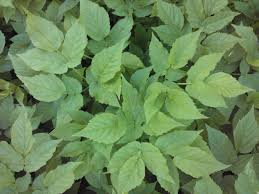
ground elder leaves

Small, white, five-petaled flowers are produced in mid-summer. Flowers are arranged in flat-topped clusters (called compound umbels) and are held above the ground on a leafy stem up to about 3 feet tall. The seeds are small and elongate, similar in size and shape to carrot seeds, and ripen in late summer. although flowering freely seedlings are not often found. the plant tends to spread from vegetative growth of the underground rhizomes.  In contrast to the dense foliage cover produced by goutweed, flowering shoots are uncommon in densely shaded areas.
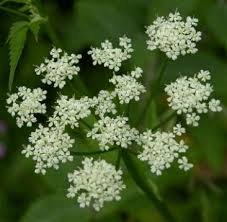
ground elder flowers
The rhizomes of goutweed are long, white, and branching, superficially resembling those of quackgrass (Elytrigia repens, also known as Agropyron repens). Patches of goutweed typically form a dense canopy and can exclude most other herbaceous vegetation.

Mabey relates that after digging up a herbaceous border removing all the rhizomes from the soil and from the roots of plants taken from the soil small shoots continued to emerge the following year.

“Here and there, near the edges of the bed, I found a few small leaflets unfolding. I carefully extricated the plants trying not to break the roots, to see what they had emerged from. Each seemed to have sprung from a small section of cut root thin enough to have been overlooked in the great cleansing. And the new shoots were growing not from nodes along the serpentine root fragments as in some species, but from a bulbous swelling at its tip.”
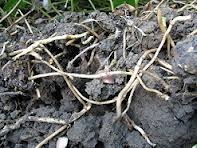
ground elder roots

History

No evidence of the presence of ground elder has been found in prehistoric excavations although it appears in Roman deposits. the Romans valued it as a medicinal herb for treating gout and as a vegetable. Mabey suggests that the plant was introduced by the Romans like the plants Alexanders and fennel, two other species introduced by the Romans that naturalised rapidly. It soon became naturalised and began to pick up folk names. The names goutweed and Bishop’s weed are references to the properties of the plant in alleviating that aliment.  Presumably Bishops were particularly prone to gout because of their high protein diet. Most peasants would not have had such a protein rich diet.  it was certainly widely cultivated as a pot herb. The first published record for ground elder is from Lyte’s herbal of 1578. Jack-Jump-About appears as a name in the sixteenth century. It was described rather ominously by Gerard in his herbal at the end of the sixteenth century in desperate tones.

“where it hath once taken roote it will hardly be gotten out againe, spoiling and getting every yeere more ground, to the annoying of better herbes”

This encroachment of ground elder is well recorded and refers to the ability of the plant to grow up to  3 feet underground in a single season. Consequently,  from one rosette an area of almost a square metre has been found colonised at the end of one year.

Invasive habit
Ground elder is an aggressive invasive plant that forms dense patches, displaces native species, and greatly reduces species diversity in the ground layer. Goutweed patches inhibit the establishment of conifers and other native tree species as well. Seed dispersal and seedling establishment is typically limited by shading, and new establishments from seed are restricted to disturbed areas. However, Aegopodium podagraria readily spreads over large areas of ground by underground rhizomes. The underground stems spread and branch below the surface usually at a depth of 1.5 to 2 inches. however Mabey reports that in a quarry in the 1990s a worker found roots of ground elder probing 30 feet below the surface.  In the angle between each scale leaf and the rhizome that bears it, there is an axillary bud that has the potential to develop into a new branch rhizome. At the end of the rhizome a leafy shoot emerges from the basal leaves from which axillary buds can grow to form rhizomes.Once established, the plants are highly competitive,  and can reduce the diversity of ground cover, preventing the establishment of tree and shrub seedlings. Because of its limited seed dispersal ability and seedling recruitment, the primary vector for dispersal to new areas are human plantings as an ornamental, medicinal or vegetable plant, as well as by accidentally spreading rhizomes by dumping of garden waste. It spreads rapidly under favorable growing conditions. Because of this it has been described as a nuisance species, and been labeled one of the “worst” garden weeds in perennial flower gardens.
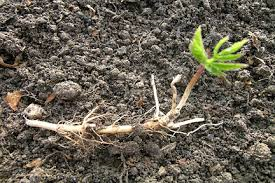
ground elder roots seedling
A. podagraria has been introduced around the world, including in North America, Australia, New Zealand, and Japan, most commonly as an ornamental plant. It readily establishes and can become naturalized in boreal, moist-temperate, and moist-subtropical climates. It is an “aggressive” invader in the upper Great Lakes region and northeastern North America, Australia, Tasmania, and New Zealand Most colonies spread to neighboring natural areas from intentional plantings, or by the dumping of yard waste that includes discarded rhizomes. It can pose an ecological threat due to its invasive nature, with potential to crowd out native species. Because of its potential impacts on native communities and the difficulty of its control, it has been banned or restricted in some jurisdictions outside its native range, including in Connecticut, Massachusetts, and Vermont in the USA.
Control

Rhizomes developing new shoots
Once established, goutweed is difficult to eradicate. The smallest piece of rhizome left in the ground will quickly form a sturdy new plant. All-green goutweed may be more persistent and spread more rapidly than ornamental, variegated goutweed varieties, making the all-green type particularly difficult to control. However, all-green, forms are known to reappear from seeds of variegated varieties. Systemic herbicides such as glyphosate (Roundup®) that are translocated to the roots and kill the entire plant are most effective for goutweed control. However, glyphosate is non-specific and can damage or kill desirable native plants that are accidentally sprayed in the course of treating the goutweed. Contact herbicides are usually ineffective because goutweed readily leafs out again after defoliation. Personally, even after treatment with glyphosate I have found the plants regrow. This weed is by general agreement one of the most difficult to eradicate, except by laborious hand weeding.
Manual
Small patches of goutweed can be eliminated by careful and persistent hand-pulling or digging up of entire plants along with underground stems (rhizomes). Pulled plants can be piled up and allowed to dry for a few days before bagging and disposing of them. Be careful to pick up all rhizomes which, if left can re-root and sprout new plants. For large patches, a team of volunteers or use of herbicide is recommended. the rhizomes penetrate not only the soil but the root system of any plants growing in that soil. therefore in order to eliminate the ground elder, it is necessary to separate any rhizomes from within the root systems of plants growing in the borders, a laborious and tiresome procedure. Any small pieces of rhizome that break off can regrow and any fragments of rhizome left in the root systems of other plats can regrow.
Mechanical
Where appropriate, frequent short mowing may control or slow the spread of goutweed in lawns, along roadsides, and other areas.
Physical
Preventing goutweed from photosynthesizing in early spring (at the time of leaf-out) can control the plant by depleting its carbohydrate reserves. This can be accomplished by covering the patch with black plastic sheeting when the leaves start to emerge from the ground in the spring, and leaving it in place through the summer. A more effective option is to cut all plants once they’ve fully leafed out, using a mower, scythe, or weed-whacker type machine, and then cover the area with plastic. Covering the plants in mid- or late summer, after they have regained substantial starch reserves, is probably much less effective.
Integrative management strategies that combine herbicide with landscape cloth, bark mulch, and hand weeding to control goutweed in a garden are largely unsuccessful because sprouting occurs from either rhizomes or root fragments left in the soil Hand pulling, raking, and digging followed by monitoring to control goutweed may be effective; however, caution must be taken to remove the entire rhizome and root system. Removing flowers before seed set may help control the spread of goutweed.] Because goutweed’s starch reserves are typically depleted by spring, removal of leaves in spring could be effective in starving the plant. Once goutweed has been removed, the patch should be carefully monitored periodically for a few years. New shoots should be dug up and destroyed. Revegetation with other plant materials is recommended.
The most effective means of control is to prevent its establishment in natural communities. It is thus recommended to plant goutweed only on sites not adjacent to wildlands and in gardens where root spread can be restricted.
Ornamental use
A variegated form is grown as an ornamental plant though with the advice to keep it isolated.
Importance to wildlife
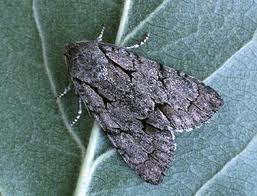
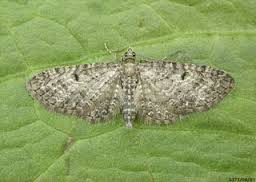
It is used as a food plant by the larvae of some species of Lepidoptera, including dot moth, grey dagger and grey pug, although A. podagraria is not the exclusive host to any of these species.
Dot Moth
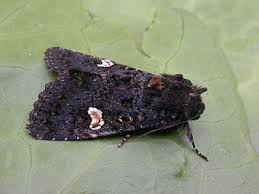
dot moth

Grey Dagger
grey dagger moth

Grey Pug
grey pug

Stem profile – no toxic look-alike has a triangular profile.
Uses as food and medicine
The plant is said to have been introduced into England by the Romans as a food plant. The tender leaves have been used in antiquity and throughout the Middle Ages as a spring vegetable, similar to spinach. It was called Bishopsweed and Bishopswort, because so frequently found near old ecclesiastical ruins. It is said to have been introduced by the monks of the Middle Ages, who cultivated it as a herb of healing. It was called Herb Gerard, because it was dedicated to St. Gerard, who was formerly invoked to cure the gout, against which the herb was chiefly employed. Descriptions of its use are found among monastic writings, such as in Physica by Hildegard von Bingen. Gerard tells us that:
‘with his roots stamped and laid upon members that are troubled or vexed with gout, swageth the paine, and taketh away the swelling and inflammation thereof, which occasioned the Germans to give it the name of Podagraria, because of his virtues in curing the gout.’

Young leaves are preferred as a pot herb. It is best picked from when it appears (as early as February in the UK) to just before it flowers (May to June). If it is picked after this point, it takes on a pungent taste and has a laxative effect. However, it can be stopped from flowering by pinching out the flowers, ensuring the plant remains edible if used more sparingly as a pot herb.
It also had a history as a medicinal herb to treat gout and atthritis] applied in hot wraps externally upon boiling both leaves and roots together. The generic name is a corruption of the Greek aix, aigos (a goat) and pous, podos (a foot), from some fancied resemblance in the shape of the leaves to the foot of a goat. The specific name is derived from the Latin word for gout, podagra, because it was at one time a specific for gout.
Ingested, the leaves have a diuretic effect and act as a mild sedative. Its use as a medicinal herb has largely declined during the modern era.

1. “The Plant List: A Working List of All Plant Species”. Retrieved 5 December 2014.
2.  a b Goutweed (Aegopodium podagraria) Mrs. Grieve’s “A Modern Herbal” at Botanical.com]
3.  a b “Plant Conservation Alliance, Alien Plant Working Group: Goutweed”.
4. Webb, D.A., Parnell, J. and Doogue, D. 1996. An Irish Flora. Dundalgan Press Ltd, Dundalk. ISBN 0-85221-131-7
5.  a b Agronomy Division (1969). “Ground elder (Aegopodium podagraria)”. Tasmanian Journal of Agriculture 40 (30): 190.
6.  a b Dawson, F. Hugh; Holland, David. (1999). “The distribution in bankside habitats of three alien invasive plants in the U.K. in relation to the development of control strategies.”. Hydrobiologia 15: 193–201. doi:10.1007/978-94-017-0922-4_27.
7. ^ “US Forest Service, Aegopodium podagraria”.
8. “The USDA PLANTS Database. National Plant Data Center, Natural Resources Conservation Service, United States Department of Agriculture. Baton Rouge, LA.”.
9. Clark, Frances H.; Mittrick, Chris; Shonbrun, Sarah. (1998). “Rogues gallery: New England’s notable invasives.”. Conservation Notes of the New England Wild Flower Society 2 (3): 19–26.
10.   Czarapata, Elizabeth J. (2005). Invasive plants of the Upper Midwest: An illustrated guide to their identification and control. pp. 215 p.
  “Ground Elder – Bishops Weed (Aegopodium podagraria)”. Edible Plants. 2009. Retrieved 2010-02-15.

12. Richard Mabey Weeds 2010 Profile books London

13. Sir Edward Salisbury Weeds and Aliens  The New Naturalist Collins London 1961
Horsetail weed of the week

Equisetum arvense  Field Horsetail  Field horsetail is part of the ancient genus Equisetum, which was the dominant plant group during the Carboniferous age more than 230 million years ago. Horsetail is easily recognised by its upright, fir tree-like shoots that appear in summer.

Rhizomes

Horsetail is an invasive, deep-rooted weed with fast-growing rhizomes (underground stems) that quickly send up dense stands of foliage.  A primitive spore-bearing plant in the family Equisetaceae.  Horsetail spreads by spores or creeping rhizomes and tubers.  Rhizomes and tubers are spread with cultivating equipment, and through this mechanism they can infest nurseries quickly. The creeping rhizomes of this pernicious plant may go down as deep as 2m (7ft) below the surface, making them hard to remove by digging out, especially if they invade a border. They often enter gardens by spreading underground from neighbouring properties or land. Fleshy tubers grow along the underground rhizomes singly or in pairs, and are positioned from a few inches to six feet deep in the soil. They store carbohydrates produced by photosynthesis, allowing field horsetail to have amazing regenerative capability and making it difficult to control.

rhizomes equisetum

 Fertile spore-bearing shoots

In spring, fertile light brown stems, 20-50cm (10-20in) tall, appear with a cone-like spore producing structure at the end of the stems. In summer, sterile green shoots develop into fir tree-like plants, 60cm (2ft) tall. Although the absence of apparent leaves, which are represented by toothed scaly sheaths at the joints renders its shading affect comparatively unimportant, its filching of soil nutrients is considerable. The freely branched furrowed green stems feel harsh with a rough flinty covering. These over ground shoots are developed from hairy blackish stems ramifying below the soil sometimes to a depth of several metres and bearing numerous ovoid dark tubers which are readily detached and commonly re-establish this weed. Two types of stems grow from the rhizome annually. The fertile stems are off-white, 10–25 cm tall and 3–5 mm diameter, with 4–8 whorls of brown scale leaves, and an apical brown spore cone 10–40 mm long and 4–9 mm broad. Un-branched brownish shoots bearing several scaly whorls and ending in a cone of many shield like structures grow in early spring, resembling short asparagus sprouts, up to a foot tall.

equisetum close up spores

They are leafless, topped by a spore-bearing cone that can be up to four inches long. Since they lack chlorophyll, they die shortly after releasing a cloud of dust like spores.  they require a film of moisture on their surface to permit fertilisation of the female cells being effected by the free swimming male sperms which are liberated from other individuals. When the fertilised egg develops it becomes another horsetail, which forms cone bearing shoots in spring and branched barren shoots in summer.

wequisetum arvense sexual generation

Sterile shoots

The sterile stems are 10–90 cm tall and 3–5 mm diameter, with jointed segments around 2–5 cm long with whorls of side shoots at the segment joints; the side shoots have a diameter of about 1 mm. Some stems can have as many as 20 segments.

equisetum stem

Sterile stems arise after the fertile stems die back. These stems are grooved and hollow, covered with whirls of feathery leaves that make it look like a green bottlebrush or a miniature conifer, and persist through the summer until the first autumn frosts. horsetails have a very high diploid number of 216 (108 pairs of chromosomes). The specific name arvense is derived from the Latin arvensis, meaning “from the meadow, field or grassland.”

equisetum arvense stand

(http://en.wikipedia.org/wiki/Equisetum_arvense)

Field horsetail is found growing in landscape beds, fields, wooded areas and along roadsides. the prevalence of horsetail in fields where the surface of the soil is likely to be very moist in the earlier months of the year is associated with the alteration of generations referred to , since once the perennial spore-bearing generation is established it appears to be comparatively indifferent to soil conditions. Therefore, whilst it is often found in moist soils, it can grow well in drier places once established, and is a common problem in gravelly soils along roadsides and railroad tracks. Field horsetail contains high levels of silica, giving rise to another common name: scouring rush; it also makes it toxic to livestock. In cross section the hollow structure can be clearly seen.

equisetum cross section

Controlling Field Horsetail

Control options include repeated mowing or mechanical removal. Although it can take years, dedicated removal of sterile stems depletes the carbohydrate reserves and will eventually exhaust the rhizome. Field horsetail grows best in full sun, and can also be controlled by shading. Mechanical removal of the stems followed by mulching with black plastic can also be effective. Tillage can make the problem worse by spreading the rhizomes and/or tubers. Removing horsetail by hand is difficult. Although rhizomes growing near the surface can be forked out, deeper roots will require a lot of excavation. Shallow, occasional weeding is not effective and can make the problem worse, as the plant can regrow from any small pieces left behind. However, removing shoots as soon as they appear above the ground can reduce infestation if carried out over a number of years.

If horsetail appears in lawns, it can be kept in check by mowing regularly.

Chemical controls

Infestations of horsetail can be weakened with weedkiller.

  • On vacant soil, where there are no herbaceous perennials, bulbs or crops, you can use Bayer Ground Clear Weedkiller containing glyphosate/flufenacet/metosulam to inhibit new shoots
  • Tough weedkillers containing glyphosate (e.g. Scotts Roundup Ultra 3000, Scotts Tumbleweed, Bayer Tough Rootkill, Bayer Garden Super Strength Weedkiller or Doff Maxi Strength Glyphosate Weedkiller or for spot treatment use Scotts Roundup Gel) can be applied in late summer when growth is strong. Before using, bruise the shoots with a rake to ensure effective (https://www.rhs.org.uk/advice/profile?PID=257)

USES

The fronds of horsetail a persistent weed of badly drained soils and lawns are covered with tiny crystals of silica . This makes them quite abrasive and they were once used for polishing pewter and arrow shafts ( Mabey ,2010). They were also used as a fine grade sandpaper for cabinetmakers (Salisbury 1961). Horsetail is a member of the Equisetaceae family; the sole survivor of a line of plants going back three hundred million years. It is a descendant of ancient plants that grew as tall as trees during the carboniferous period of prehistoric times and members of this family gave rise to many of our coal deposits. Since being recommended by the Roman physician Galen, several cultures have employed horsetail as a folk remedy for kidney and bladder troubles, arthritis, bleeding ulcers, and tuberculosis. The Chinese use it to cool fevers and as a remedy for eye inflammations such as conjunctivitis and corneal disorders, dysentery, flu, swellings and haemorrhoids. (http://www.herbwisdom.com/herb-horsetail.html). Horsetail, or Equisetum arvense, is an herb that has historically been used as a diuretic to make you urinate more frequently. Diuretics affect the kidneys, increasing the amount of water and salt that are released into the urine. For people with kidney problems or edema (when the body holds onto fluid), getting rid of unwanted fluid and salt can be an important part of treatment. (http://www.healthline.com/health/does-horsetail-help-you-pee).

  1. Hyde, H. A., Wade, A. E., & Harrison, S. G. (1978). Welsh Ferns. National Museum of Wales ISBN 0-7200-0210-9.
  2.  Flora of North America: Equisetum arvense
  3.  Bebbington, A. “Toxicity of Equisetum to Horses”. Retrieved 1 December 2010. 
  4. ^ Howard, Michael. Traditional Folk Remedies (Century, 1987); p.159-160
  5. (http://oregonstate.edu/dept/nursery-weeds/weedspeciespage/horsetail/Equisetum_arvense_horsetail.html).
  6. (http://en.wikipedia.org/wiki/Equisetum_arvense)
  7. (https://www.rhs.org.uk/advice/profile?PID=257)
  8. (http://extension.psu.edu/plants/green-industry/news/2012/weed-of-the-month-field-horsetail-equisetum-arvense)
  9. Sir Edward Salisbury 1961 Weeds and Aliens New Naturalist Collins London
  10. Richard Mabey 2010 Weeds Profile books London 2010

Field bindweed Convulvulus arvensis Weed of the Week

Other common names, mostly obsolete, include lesser bindweed, European bindweed, withy wind (in basket willow crops), perennial morning glory, small flowered morning glory, creeping jenny, and possession vine. It is called leli in Punjabi.

Convolvulus arvensis (field bindweed) is a species of bindweed in the morning glory family, native to Europe and Asia. When unimpeded, wiry stems often grow more than 3 feet long and intertwine to form prostrate web-like mats or climb any nearby plant, fence or wall. It has perfected a whole arsenal of survival techniques that have ensured it is one of the most intractable species of weed.
Structure.

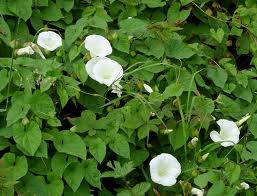
Leaves are most commonly arrow-shaped, 1/2 to 1 1/4 inches long, and are arranged alternately along the stem.
bindweed

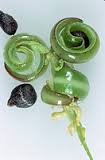
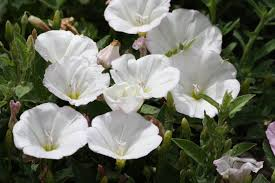
Funnel-shaped, white or pinkish flowers, approximately 1 inch in diameter, are borne on stalks that grow in leaf axils.  Flowers have a light almond fragrance.  The nectar of the flowers attracts a large number of insect species. Several pink stripes are sometimes present on the underside of the flower, extending from the base of the flower to the tip of the petal.
bindweed flowers

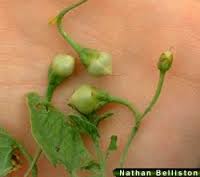
The flower stalk also bears two tiny bracts 1 inch below the flower. Though most field bindweed seeds germinate by early summer, seeds can germinate anytime between early spring and late autumn. This variation in germination time is one of the strategies by which field bindweed ensures its survival. Seedlings may appear from seeds buried for up to 50 years. The longevity of the seeds providing another strategy of persistence.  bindweed seeds

Once the seedling is established the plant extends underground horizontally. The underground system may extend 30 square yards in a season and the vertical roots can penetrate to a depth of eighteen feet. New shoots may generate from the underground stems or from the roots. When the roots are cut the growth of new roots is promoted although the plant is temporarily weakened.  the plant has a rapid system to regenerate following damage. Once the shoot is cut a milky sap oozes from the cut and seals the cut forming a callus. Dormant buds near to the site of the cut are stimulated to generate new roots and stems. Therefore even if the plant is chopped into pieces each piece will form a new bindweed plant. It the plants are repeatedly cut the bush develops a multi-stemmed form generating multiple branches. If the stems are buried they can take root. If the plants are eaten  by animals they are stimulated to grow even faster. Flowers last only 1 day, and are produced throughout the summer. Freezing temperatures in autumn cause shoots to die back, although most roots remain intact. In the laboratory field bindweed has been shown to be able to find its way to a light source through a maze of blackened tubes.
Field bindweed produces a tap root which can penetrate up to 18 feet in depth. Many spreading roots grow laterally from the tap root, sometimes extending 30 feet. The extensive root system allows the plant to compete successfully with other plants and survive harsh conditions, such as drought and intense cold. Chemicals secreted by the roots are thought to interfere with the germination of some crop seed. Buds develop on the lateral roots, producing underground rhizomes and aboveground shoots.
bindweed roots 2

Field bindweed rhizomes and stems break easily, and when fragmented, underground plant parts will produce new plants.
One plant can produce as many as 14 shoots in 1 year, each of which grows 1 ½ – 4 ½ feet in the first season. Those shoots shaded by other plants will adopt a climbing habit to reach light. Each plant is capable of producing 25-300 seeds, which generally fall near the parent plant. However, seeds can also be carried by water, in mud stuck to
vehicles or shoes, and by birds or other animals that consume them. Due to an extremely hard seed coat, some seeds can
remain viable in the soil for more than 50 years.

Problems with Bindweed
Although it produces attractive flowers, it is often unwelcome in gardens as a nuisance weed due to its rapid growth and choking of cultivated plants. It was most likely introduced into North America as a contaminant in crop seed as early as 1739, as an invasive species. Plants typically inhabit roadsides, grasslands and also along streams. Its dense mats invade agricultural fields and reduce crop yields.
In one of the tales collected by The brothers Grimm, Our Lady’s Little Glass, this flower is used by The Virgin Mary to drink wine with when she helps free a wagoner’s cart.  Obviously she didn’t drink wine in the quantities that most of us do. The story goes on to say that “the little flower is still always called Our Lady’s Little Glass.”

. Control of bindweed
High light conditions are optimal for field bindweed and it is not seen in heavily shaded conditions thriving in areas with bare soil or sparse plantings. Consequently blocking the plants from reaching light is at the core of many of the strategies for its control.  Mulch can help prevent bindweed growth by blocking light. Desirable plants that produce early, vigorous growth can create a shady environment for the prostrate-growing field bindweed and put it at a competitive environment for the prostrate growing of field bindweed putting it at a disadvantage. Young seedlings can be destroyed when cut several inches below the soil. Hoeing, digging, or tilling more mature field bindweed every 1-2 weeks for several seasons can reduce plant vigour, and eventually allow for some control to be achieved. Personally I have found fighting with this plant for dominance of the garden to be a constant battle. The best that I could attain was a truce, but if I neglected to watch for the small shoots I would be under attack again. Whilst I think the flowers are very pretty and delicate the plant will completely smother any plant it can utilise for support. Basically it is a thug.
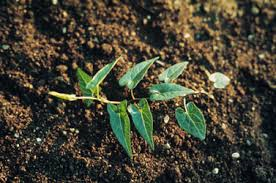
bindweed seedling

Ecological importance
Many insects visit field bindweed for pollination. The plant has been used as a remedy for spider bites and for female problems, among other things (what a lovely euphemism, I suspect it doesn’t mean pain from wearing high heels or sitting next to a sweaty bloke who has never used deodorant on the tube). Its stems have been used for cordage, (let us hope they didn’t throw the cord on the soil when they had finished with it) and its leaves and stems have properties that can destroy mosquito larvae. Although some grazing animals will consume field bindweed, it produces poisonous alkaloids and can accumulate toxic levels of nitrates. The plant can serve as a host for several viruses that affect potatoes, tomatoes and other crops. Its presence in crops can also interfere with harvest and significantly reduce yields.

Galium aparine L. cleavers

Galium aparine L. cleavers,
Also called clivers, goosegrass, kisses, stickyweed, stickybud, sticky willy
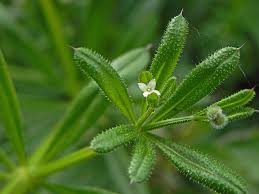
This species is a straggling climber, growing up to 3 m long, with slender 4-angled stems. Its narrow leaves can reach 7 cm long and are arranged in groups (whorls) of 6-8 (rarely 4) around the stem.

Goosegrass plant
Goosegrass plant

This is a scrambling annual whose stems may reach up to five feet in hedgerows, fields and gardens where it flourishes. It clings by the curved hook-like prickles on the four angles of the stems and the edges of the leaves.
Indeed the whole plant is covered in minute hooked hairs, and can cling to skin, fur and clothing. It has been raised from the excreta of various birds demonstrating that it is consumed by them. Viable seeds have also been found in manure and compost showing that they are resistant to the heat required to decompose manure and compost and that they are persistent. The flowers are tiny (2mm across), white, 4-petalled tubes. The fruits are purplish green covered with numerous colourless joked bristles, often borne in clusters of two or three. The individual fruits are approximately 2mm to 2.5 mm across and weighs approximately 0.02 to 0.05 grams. Germination mostly occurs in autumn but may occur in spring. In harsh winters it is the latter that survives. The germination in different seasons is a characteristic that has enabled this plant to proliferate.
goosegrass flowers

These fruits are also covered in hooked hairs which catch in the fur of passing animals or the peoples clothing. This is an efficient distribution mechanism that has contributed to the plant’s wide geographical range.
goose grass seed

.It is well known by children for its ‘stickiness’, owing to its covering of hooked hairs. There is a rather cruel Scottish children’s game involving this plant. The trick is to persuade somebody to allow a piece of it to be put in their mouth – then pull it out fast. The hooks being rather sharp, the game is called ‘bleedy tongues’! Galium aparine is also well known by herbalists for its medicinal properties.

goose grass close up
Geography and distribution
Galium aparine is naturally widespread throughout Europe, North America and some parts of Asia, and occurs as far north as Alaska and Greenland. Its seeds have been recorded from deposits of Paleolithic or Mesolithic Age, which render it less probable that it owes its presence to conditions created by man, despite being especially associated with habitat conditions that are partially artificial. It can grow at heights of up to 1500 feet above sea level. It has been introduced as far south as Australia, New Zealand, and the sub-Antarctic Islands. It can be a prolific weed of cereal crops (especially in Europe and North America). Heavy infestation can cause significant yield losses, and its seeds can be difficult to separate mechanically from those of crops such as oilseed rape (canola). It is found throughout the British Isles (except in some places in the far north) and appears to be increasing in abundance in recent years despite the use of species-specific agricultural herbicides. Galium aparine can be found growing naturally on scree slopes and shingle banks.

Folklore
Used as a love medicine by one tribe, the infusion of plant was used as a bath by women to be successful in love. Also used as a hair tonic, said to be good for the hair, making it grow long. Several Native American Tribes used an infusion of the plant for gonorrhea. A red dye is obtained from a decoction of the root, it is said to dye bones red. It was also believed to remove freckels. Gerard writes of Clivers as a marvelous remedy for the bites of snakes, spiders and all venomous creatures. A thick matt of the stems, when used as a sieve for filtering milk, was said to give healing properties to the milk
http://www.altnature.com/gallery/cleavers.htm
John Ruskin went so far as to trace out aesthetic and moral standards for flowers labelling weeds as unfinished. He argued that it was unnatural for a plant to have a cluster of bristles springing from its centre. Interestingly the term weedy when applied to humans has connotations of weakness or feebleness rather that those of strength and intimidation characteristics of many weed species.

Uses
This is not a recommendation merely information
The whole plant is edible, though not particularly tasty, and in China, for example, it is eaten as a vegetable. In times of war of famine it has been eaten possibly from desperation rather than as a delicacy. Its seeds can be roasted to prepare a sort of coffee substitute. It is also reputed to have a number of medicinal properties, having been used in traditional medicine (usually as an infusion) to treat kidney problems, skin disorders and high blood pressure among other ailments. Archaeological evidence suggests that it may have been used in this way for hundreds, if not thousands, of years. Cleavers is still used by medical herbalists today, although scientific evidence regarding its effectiveness is still lacking.
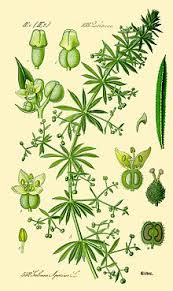
botanical drawing of goosegrass
Britain’s wild harvest
Kew’s Sustainable Uses of Plants Group undertook a survey of commercial uses of wild and traditionally managed plants in England and Scotland for the Countryside Agency, English Nature and Scottish Natural Heritage to determine the economic role of wild plants and to assist in their sustainable use. Despite the revival of interest in herbal remedies in UK most plant material used in herbal products is imported. However, there are exceptions. In Norfolk, for example, cleavers is gathered from hedgerows and used in herbal products.

Millennium Seed Bank: Seed storage
Kew’s Millennium Seed Bank Partnership aims to save plant life world wide, focusing on plants under threat and those of most use in the future. Seeds are dried, packaged and stored at a sub-zero temperature in our seed bank vault.
Cultivation
This weedy species is an annual that can be grown in temperate regions, in parts of the garden managed for wildlife, as either a summer or winter annual (or occasionally as a biennial). The seed is thought to be viable for around 2-6 years unless frozen. Seeds should be sown in moist soil, preferably a rich loam, with above-average fertility and pH of 5.5-8.0. Seeds must be buried to germinate, ideally at a depth of 2-10 mm. Seeds that have passed through the gut of a herbivore are thought to have a higher germination rate. Development is rapid with flowers appearing as soon as eight weeks after germination. Ripe seeds develop from summer through to autumn, depending on the region in which plants are grown. Supports such as pea sticks can be provided, as this plant likes to scramble. Plants will die down after the fruits are released at which point seeds must be collected for next year’s plants.
Note that this plant can be invasive. In some parts of the world it is a serious weed of crops and native vegetation, where it can out-compete indigenous species. For this reason, if cultivating cleavers, care should be taken to prevent its spread into farmland or sensitive areas of conservation importance.
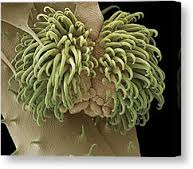
hooks on seeds

Climbing mechanism of Galium aparine.
Galium aparine is a herbaceous climbing plant that attaches to host plants mainly via its leaves, which are covered by hooked trichomes. Although such hooks are found on both leaf surfaces, the leaves of G. aparine are mainly positioned upon the leaves of supporting plants and rarely beneath. In order to understand the mechanism underlying this observation, we have studied structural and mechanical properties of single leaf hooks, frictional properties of leaf surfaces, turgor pressure in different leaf tissues and bending properties of the leaves in different directions. Abaxial and adaxial leaf hooks differ significantly in orientation, distribution, structure and mechanical properties. In accordance with these differences, friction properties of leaves depend on the direction of the applied force and differ significantly between both leaf surfaces. This results in a ratchet mechanism. Abaxial leaf hooks provide strong attachment upon the leaves of adjacent plants, whereas adaxial hooks cause a gliding-off from the underside of the leaves of host plants. Thus, the leaves of G. aparine can function as attachment organs, and simultaneously orient themselves advantageously for their photosynthetic function. Further adaptations in turgor pressure or concerning an anisotropy of the flexural stiffness of the leaves have not been found.
goose grass showing hooks

Always on the bright side: the climbing mechanism of Galium aparine
Georg Bauer,1 Marie-Christin Klein,2,3 Stanislav N. Gorb,2,3 Thomas Speck,1 Dagmar Voigt,2,3 and Friederike Gallenmüller1,*
Author information ► Article notes ► Copyright and License information ►
This article has been cited by other articles in PMC.

References and credits
Allen, D.E. & Hatfield, G. (2004). Medicinal Plants in Folk Tradition: an Ethnobotany of Britain and Ireland. Timber Press, Portland.
Bown, D. (2008). The Royal Horticultural Society Encyclopedia of Herbs and their Uses. Dorling Kindersley, London.
Gucker, C. (2005). Galium aparine. Fire Effects Information System [Online]. U.S. Department of Agriculture, Forest Service, Rocky Mountain Research Station, Fire Sciences Laboratory (Producer). Available online
Milliken, W. & Bridgewater, S. (2004). Flora Celtica –Plants and People in Scotland. Birlinn, Edinburgh.
Prendergast, H.D.V. & Sanderson, H. (2004). Britain’s Wild Harvest: The Commercial Uses of Wild Plants and Fungi. Royal Botanic Gardens, Kew and The Countryside Agency, London.
Preston, C.D., Pearman, D.A. & Dines, T.A. (eds) (2002). New Atlas of the British and Irish Flora: an Atlas of the Vascular Plants of Britain, Ireland, the Isle of Man and the Channel Islands. Oxford University Press, Oxford.
Kew Science Editor: William Milliken
Kew contributors: Steve Davis (Sustainable Uses Group)
Copyediting: Emma Tredwell
While every effort has been taken to ensure that the information contained in these pages is reliable and complete, the notes on hazards, edibility and suchlike included here are recorded information and do not constitute recommendations. No responsibility will be taken for readers’ own actions.
http://www.kew.org/science-conservation/plants-fungi/galium-aparine-cleavers
Richard Mabey 2010 Weeds Profile books London
Edward Salisbury 1961 Weeds and Aliens Collins Press London
Weed of the week QUACKGRASS Elytrigia repens

couch grass

Essex skipper

couch grass structure

rhizome of couch grassQUACKGRASS Elytrigia repens

Other common names include Couch grass, scutch grass, twitch grass

Appearance of Couch Grass

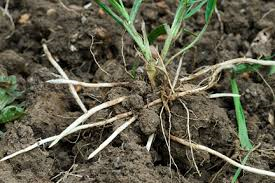
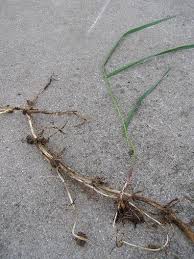
  • Couch grass is a common and invasive garden weed. It is a perennial grass which rapidly spreads by rhizomes (underground stems). Root system – The slender, extensively spreading rhizomes (horizontal underground stems) are white to pale yellow, with brownish sheaths at the joints (nodes), giving them a scaly appearance. Tips of the rhizomes are sharply pointed. Rhizomes can grow 3 to 11 feet long, and form a dense mat. Most rhizomes are found within 4 to 6 below the soil. Fibrous roots are produced at the nodes.
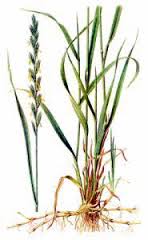
  • Stems – Stems are erect, smooth, round and unbranched. They can grow 1 to 4 feet tall and, like most grasses, are hollow.
  • Leaves – Leaves are rolled in the bud. The leaf blade (free part of the leaf) is dull grayish-green (sometimes dark green), thin, flat and finely pointed. Blades are finely ribbed on upper and lower surfaces, and measure 1 1/2 to 8 inches long (sometimes up to 12 inches) and 1/8 to 1/4 inch wide (sometimes up to 1/2 inch). The upper blade surface and margins are typically rough or slightly hairy, and the lower surface is smooth. The base of the blade is often lighter in color. The leaf sheath (part of the leaf surrounding the stem) is round and short, with overlapping margins. Lower sheaths are usually hairy, while the upper sheaths are smooth. The ligule (projection inside on the top of the sheath) is membranous and very short (1/50 to 1/25 inch long). A pair of whitish-green, brownish or reddish, narrow, claw-like appendages (auricles) clasp the stem at the junction between the leaf blade and sheath.
  • Flowers – Flowers are arranged in a long, slender, unbranched spike (2 to 10 inches), resembling a slender head of wheat. The yellow-brown seeds (1/5 to 1/3 inch long) are elongated toward the tip, tapering to a blunt base, and topped with a ring of hairs. Seeds of couch grass s germinate in early spring, and flowering occurs from late May to September. Flowers are wind-pollinated and relatively self-sterile. One  plant can produce up to 400 seeds per season, but most plants produce fewer than 50 seeds. Seeds are short-lived, and are reported to lose viability within 4 years. Seeds have been found to remain viable after passing through the digestive tracts of horses, cows and sheep, but not after passing through pigs.

Distribution

Couch grass has become naturalised throughout much of the world, and is often listed as an invasive weed. Interference of this species with crops can cause yield reductions (up to 85% in corn) and can also result in delayed corn maturity. It is an alternate food source for several insect and disease pests of grain, such as the cereal leaf beetle (Oulema melanopa) and bromegrass mosaic virus. According to a botanical publication from 1672, it was introduced into New England by the colonists for forage. Quackgrass is typically found in crop fields, roadsides, river banks, lawns, waste places and abandoned fields. It is often used for hay and pasture. This species can grow in a variety of soil types, and has a high tolerance for drought and salinity. It prefers neutral to alkaline soils.

The Problems with Couch Grass

Couch grass or twitch grass (Elymus repens) is an old enemy for many gardeners. Its wiry, underground stems and creeping shoots pop up around garden plants and before long can take over a bed. As a perennial weed thorough killing or eradication of the roots is necessary.

The network of rhizomes become entangled in clumps of herbaceous perennials and among shrubs and fruit bushes causing great problems, as they are difficult to remove. Couch can easily spread from infested lawns into adjacent borders.

Couch is usually spread from garden to garden unwittingly when small sections of rhizomes become hidden among the roots of plants or in manures or soil.

Regular chopping of rhizomes through cultivation can be an effective way of controlling quackgrass infestations.. It is very difficult to remove from garden environments, as the thin rhizomes become entangled among the roots of shrubs and perennials, and each severed piece of  rhizome can develop into a new plant. Research has found that 30% of 1/8 inch fragments of quackgrass rhizomes were capable of producing aerial shoots It may be possible to loosen the earth around the plant, and carefully pull out the complete rhizome. This is best done in the spring, when disturbed plants can recover. Another method is to dig deep into the ground in order to remove as much of the grass as possible. The area should then be covered with a thick layer of woodchips. To further prevent re-growth cardboard can be placed underneath the woodchips. The long, white rhizomes will, however, dry out and die if left on the surface. Some herbicides will also control it. The growth of rhizomes of Elymus repens (L.) Gould (couch grass) from single-node fragments on plots sown with six perennial grasses was reduced by a factor of 10, compared with initially bare plots. The location of shoot complexes of E. repens after three seasons indicated that Arrhenatherum elatius and, to lesser extents, Agrostis stolonifera or Dactylis glomerata, prevented couch growth more than Holcus lanatus or Poa trivialis. Strips of sown grass at the edge of arable fields may therefore reduce the spread of couch grass into adjacent crops. Fertiliser application of 32 kg N ha−1 doubled the amount of couch rhizome. Mefluidide and paclobutrazol, plant growth regulators which might be used to manage sown grass, had minor effects on rhizome structure. D. glomerata did not spread from where it was sown and was largely uninvaded by other species. The herbicide, N-phosphonomethyl glycine (glyphosate), is readily absorbed by the foliage and translocated in the phloem of couch grass. Despite the reduction in growth in plots where perennial grasses coexist there is no herbicide that will control couch without killing different grass species around the plant.

Ecological relevance of Couch Grass

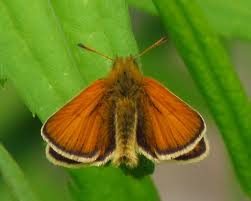
The foliage is an important forage grass for many grazing mammals The seeds are eaten by several species of grassland birds, particularly buntings and finches. The caterpillars of some Lepidoptera use it as a foodplant, e.g. the Essex Skipper (Thymelicus lineola).

Uses of Couch Grass

Couch grass has valuable uses. It remains green all year round and can make good forage and hay. Total crude protein content is comparable to timothy (Phleum pratense). Nitrogen levels in couch grass are high enough, without reaching toxic levels, to be appropriate for cattle feed, although biomass productivity and palatability are generally low. Couch grass can be used to prevent soil erosion, and it is effective in removing nutrients from wastewater effluent when sprayed on soil.

The dried rhizomes of couch grass were broken up and used as incense in mediaeval Northern Europe where other resin-based types of incense were unavailable.

Medicinal uses

Couch grass it valued by herbalists for its mucilage rich rhizome. rhizomes have been used in the traditional Austrian medicine against fever, internally as a tea, syrup, or cold maceration in water, or externally applied as a crude drug.

A tea made from the roots is useful for treating urinary infections because of the herb’s broad antibiotic, and diuretic properties. One of the chemical constituents, agropyrone, has been shown to have strong antibiotic properties. Couch grass tea will also soothe and coat an inflamed sore throat, and helps clear phlegm. The herb contains mucilage that helps to clear congestion while it coats the throat. Other sources report that it has been used to treat gout, rheumatic diseases and chronic skin conditions. For all of these remedies there is a lack of clinical studies to support its efficacy.

Folklore

Couch grass is reputed to have been used in folk magic and the occult. The ‘power’ comes from the fact it has an irritating quality. This irritation is believed to be used to cause discomfort or pain to ones enemies as well as to shake up couples.