Dandelion myths, legends and folklore

DANDELIONS MYTHS AND FOLKLORE


Dandelions are one of the most colourful, profuse and perverse plants. With such characteristics as these, it is to be expected that a number of myths and legends have grown up around these plants. Dandelions have been used for food and medicine for many years. As a consequence of their usefulness and bright colour most of the symbols and myths surrounding them are positive.

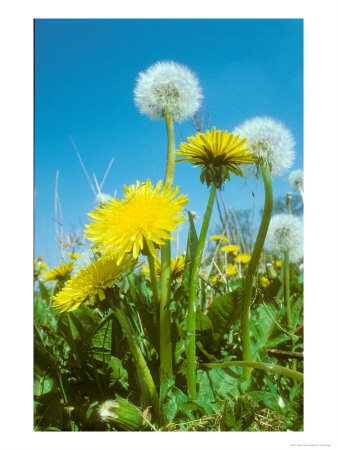
  Woven into a wedding bouquet, they are meant to be good luck for a newly married couple. When dandelions appear in dreams, they are thought to represent happy unions. They are also considered to be symbols of hope, summer and childhood.  Many beliefs centre on dandelions answering questions or bringing good luck. When the seeds are blown of a dandelion it was said to carry thoughts and affections to a loved one. (1)

 In medieval rituals, dandelions being the colour of gold were used to predict whether a child would be rich when the flower was held beneath the chin,a the golden glow indicated the child would be rich. In 18th century England children held the dandelion under their chin and the more golden the glow the sweeter and kinder they were.(1)


One legend surrounding these flowers was that the tallest dandelion stalk that a child could find in the early spring will show how much taller they will grow in the coming year. Dandelions have also been used as a variation on the daisy petal plucking past time of “he loves me, he loves me not” If you blow on a white dandelion head and every seed scatters then you are loved. If some seeds still cling to the stalk, then your intended has reservations about the relationship.
.

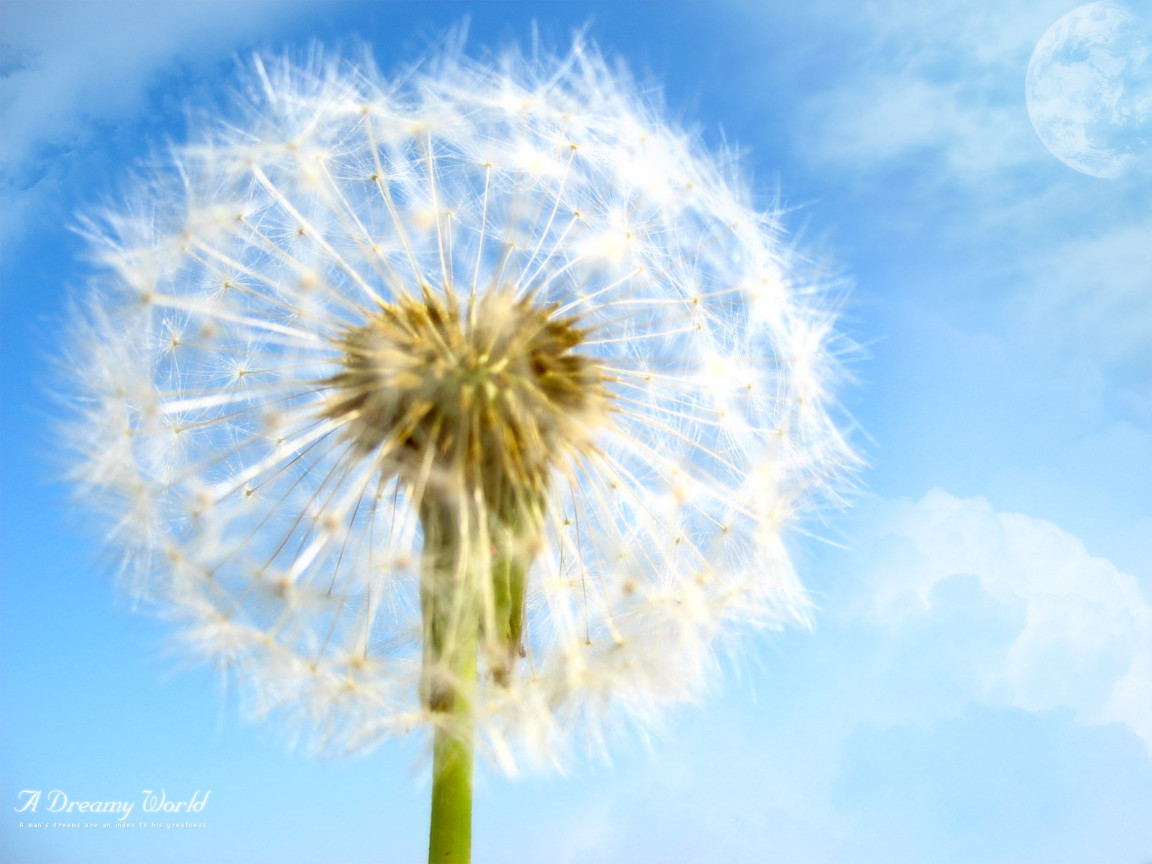
 It is also said that if you make a wish immediately before blowing on dandelion, your wish just might come true. Another belief was that the number of seeds left after blowing the seed head indicated the number of children that a girl would have in later life.(5)

According to Scott Cunningham, author of over thirty books on herbs and Wicca, Dandelion is said to increase psychic abilities when taken as a tea. A tea of the roots left steaming and placed beside the bed will call spirits. Dandelion buried in the northwest corner of the house will bring favourable winds.(5)

Others claim that the number of seeds remaining after blowing the seed head, are how many years you have left to live. A common belief is that the number of seeds left is the time, this gave rise to the term dandelion clock for the seed head. The dandelion flower opens an hour after sunrise and closes at dusk giving rise to the belief that it is a ‘Shepherd’s clock’(3).

 The property of the pappus hairs to close when moist has led to another belief. The dandelion is an excellent barometer, one of the commonest and most reliable. It is when the blooms have seeded and are in the fluffy, feathery condition that its weather prophet facilities come to the fore. In fine weather the ball extends to the full, but when rain approaches, it shuts like an umbrella. If the weather is inclined to be showery it keeps shut all the time, only opening when the danger from the wet is past.(4)

  However, dandelions are symbols of grief and the Passion of Christ in theological symbolism as well as being one of the bitter herbs of the Passover. (6)

The sticky white sap was used as a folklore cure for warts and corns (1). . As all parts of the plant may be eaten dandelion is a valuable survival tool.

  Dandelions were intentionally transplanted from Europe over to the New World in the early days of the American Colonies they have become ubiquitous and spread across the continent. Dandelions are used as folk remedies in North America, Mexico and China. More of that in medicinal uses of dandelions


  1. 1.       http://www.healthsmartsantafe.com/article/pdf/article-317.pdf
  2. 2.       Unusual Vegetables, Something New for this Year’s Garden, Rodale Press Emmaus, PA.
  3. 3.       Folkard (448. 309), from “The Child and Childhood in Folk-Thought,” by Alexander F. Chamberlain
  4. 4.       Camping For Boys by H.W. Gibson

5. Dandelion Magick: Wonder Plant of Mind, Body and Spirit http://www.suite101.com/content/dandelion-magic-a24342#ixzz1JKJt5SlX

6. http://home.intekom.com/herbsorganic/pages/working%20on/dandelion/dandelion.htm
DANDELIONS WEED OF THE WEEK Biology and classification (via changinglifestyleblog)

I think my life would be boring to write about so I am writing about what I am really passionate about which is plants.

DANDELIONS WEED OF THE WEEK Biology and classification Taraxacum is a large genus of flowering plants in the Family Asteraceae. They are native to Eurasia and two species are found worldwide. They have very small flowers (florets) collected together into a composite flower head. Some species produce seeds without the need for fertilisation apomictic these include the common dandelion Taraxacum officiale. It is possible that many species such as dandelions originally came from landslides moraines beac … Read More

via changinglifestyleblog

DANDELIONS WEED OF THE WEEK Biology and classification

Taraxacum is a large genus of flowering plants in the Family Asteraceae. They are native to Eurasia and two species are found worldwide. They have very small flowers (florets) collected together into a composite flower head. Some species produce seeds without the need for fertilisation apomictic these include the common dandelion Taraxacum officiale.

It is possible that many species such as dandelions originally came from landslides moraines beaches, dunes or similar habitats. It may be that the post glacial period was when many of the micro species of dandelion became differentiated especially as their production of seeds exhibits features such as apomixes that are often met with in artic or sub artic situations.

Dandelions are unaffected by day length and can flower at any time of the year.

Dandelions have been found growing at heights up to 2700 feet above sea level. Seedlings have been raised from bird excreta and therefore the seed can pass through the digestive tract of a bird unharmed.

 All dandelions have a basal rosette of leaves. Each year leaves are produced above those of the previous season, but the root undergoes a periodic longitudinal contraction often amounting to between 20 to 30% of its length which consequently ensures the leaf rosette remains at ground level.

Incidentally it is this feature that enables the dandelion to suppress other herbage in the short turf around. Dandelions have a milky juice that exudes on wounding and, like blood, congeals to form a protective scab. They also show a capacity to regenerate from small portions, even the lowest of the fleshy tap root. The leaf form of common dandelion is extremely variable. In the seedling and juvenile stage the leaves may be devoid of any lobbing and scarcely toothed. As the plant becomes older the successive leaves develop more and more lobes with the typically back curved segments. However, if the rosette of an adult plant be removed, the leaves of the new shoots revert to the juvenile form.


From the centre of this rosette arise the flower heads; these are borne upon hollow leafless tubular stems and each consists of numerous strap shaped yellow to orange coloured flowers enclosed by a number of protective green bracts. The flower heads close at night, when the protective bracts completely ensheathe the flowers; they open in response to light stimulus and high temperatures, a reaction that takes an hour to complete.  A rosette may produce several flower stems at a time. After flowering, the flower head dries for approximately 24-48 hours. The dried petals and stamens drop off, the sepals recurve and the parachute opens. Common dandelion produces seed heads that contain up to 400 or more achenes, but the average is about 180. Germination which is often over 90% can occur soon after being shed but these seedlings do not flower until the following season. The reproductive capacity of the common dandelion in one season is usually about 2,000.


Red veined dandelion Taraxacum spectibilia is a low short growing perennial, the leaves are often dark spotted with a reddish stalk and midrib. Flower heads are 20-35mm the outer florets are sometimes reddish or purplish beneath. The achene body narrows gradually at the apex where it passes into the beak; And sepal like bracts broad and often closely pressed but not recurved. It flowers from April to August in moist and wet places often in mountains.

 Taraxacum palustria has narrower leaves than the others which are very finely toothed or untoothed. It is neither spotted nor reddish. The sepal like bracts are broad and closely pressed with a pale broad margin. In  Taraxacum  paludosum the fruit passes abruptly into the beak It flowers between April and June and can be found in stream sides, marshes and fens.

 The other two dandelions have in the adult state, leaves with normally quite pronounced lobes, often of unequal size and the larger curved towards the base of the leaf-blade. In both the outer bracts are usually curved backwards. Taraxacum vulgare  is a low short perennial with flower heads 30-35mm outer florets sometimes  grey violet beneath sometimes reddish or reddish purple never red. Sepal like bracts are broader than lesser dandelion but narrower than red veined dandelion. Erect or recurved. It flowers all year, but especially in April to June. The colour can be variable but not purplish red.  Its habitat consists of grassy and waste places. It is common throughout Europe.

Our common dandelion Taraxacum officiale which flourishes on a diversity of soil types especially the heavier chalk ones, has the familiar golden flower heads that are often 2 inches across. On the drier types of soil, especially the sandy ones, another dandelion is sometimes common; this has smaller flower heads, often less that an inch across and the colour is pale yellow. From strains of the common dandelion with small flower heads this small dandelion (Taraxacum laevigatum) can be distinguished by the excrescence on the outer face of the tip of the inner bracts, which give these a split appearance. Lesser dandelion Taraxacum erythrosperma has smaller flowers 15-25mm sepal like bracts narrowly apressed, the tips of the inner bracts appearing forked. It flowers throughout Europe between April and June in dry grassy and bare places especially on lime.


References

Salisbury E Weeds and Aliens Collins London 191-193(1961)

Fitter R Fitter A Blamey M the wildflowers of Britain and Northern Europe Collins  254 (1978)

Phillips  EP the weeds of South Africa Union department of agriculture (1938)